
Removal & remediation
Asbestos abatement, mold removal, lead paint work and demolition — under full containment, cleared by laboratory results, and documented so the file holds up years later.
Once a hazard is identified, it has to be removed safely and to code. Superior Environmental Services is a licensed contractor handling asbestos, mold, lead, and demolition work for homeowners, general contractors, and property managers — with the containment, documentation, and clearance testing that keep your project compliant.
Call (469) 283-5227What we remove
Removal is the half of this work where mistakes get expensive. Every one of these jobs is regulated, every one produces waste that has to be manifested, and every one ends with documentation you will need again later — at a closing, a permit desk, or in a claim.
Call (469) 283-5227Licensed removal under full containment with negative air, followed by independent clearance testing before the containment comes down. Texas requires notification to the state before work starts, and that timeline is longer than most people plan for.
Containment, HEPA filtration, removal of affected porous material and antimicrobial treatment of what stays. The part that decides whether it comes back is not the cleaning — it is finding and fixing the moisture source first.
Removal and stabilization under the EPA Renovation, Repair and Painting rule, which governs any disturbance of lead paint in pre-1978 housing and child-occupied facilities. Often stabilization rather than removal is the correct call, and it is a great deal cheaper.
Interior and structural demolition with the hazard work sequenced ahead of it. A pre-demolition asbestos survey is a federal requirement before a structure comes down, and it is the single most common reason a demo date slips.
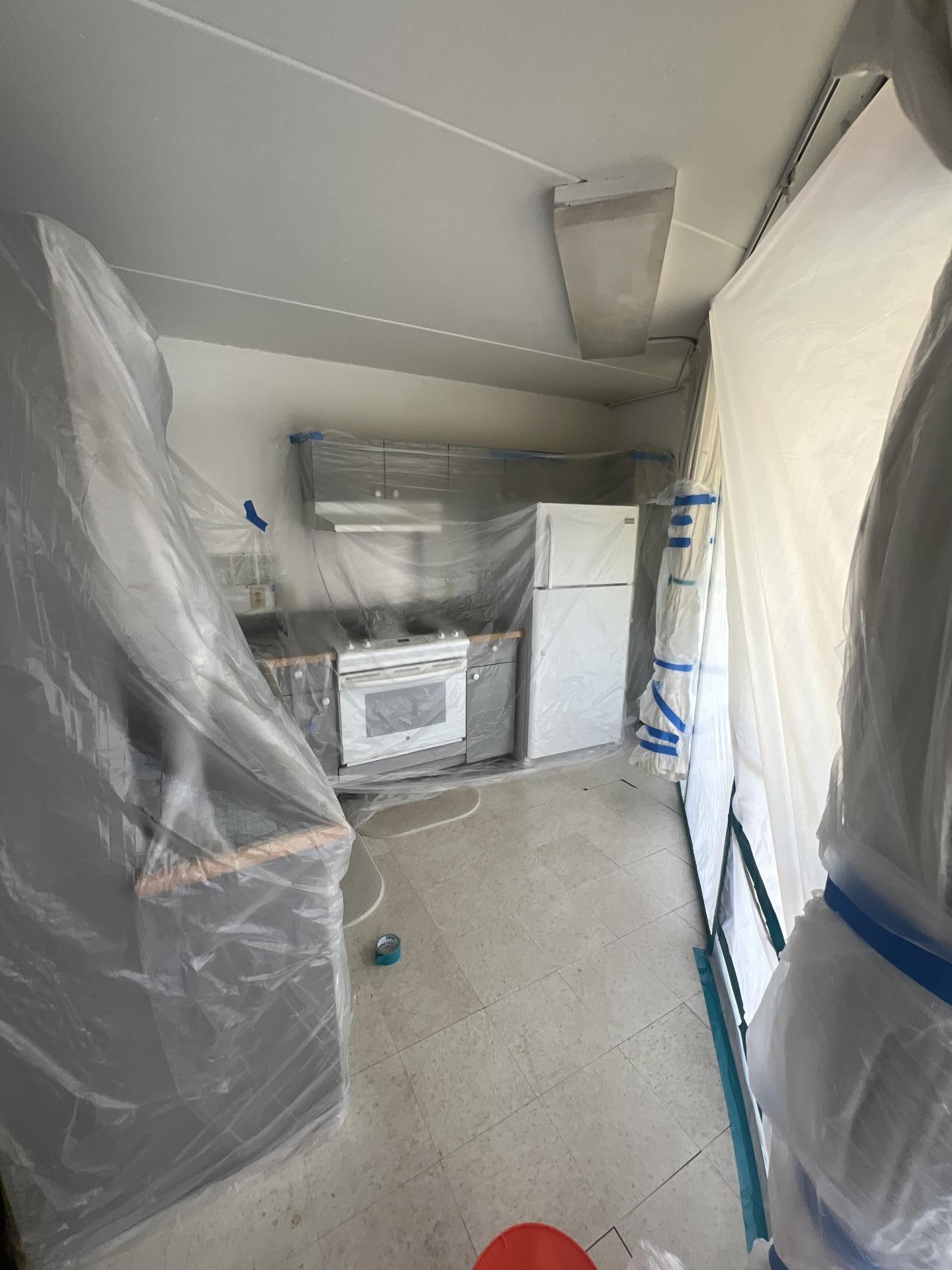
Where the money goes
People are often surprised that removing a small amount of material costs what it does. Almost none of that number is the removal. It is the engineering that keeps the rest of the building clean while it happens.
The room stops being part of the building
Openings, vents and returns are sealed. The HVAC is shut down and isolated so the ductwork does not distribute what you are trying to contain.
Air flows in, never out
HEPA-filtered negative air machines hold the work area below the pressure around it. Any leak pulls clean air inward rather than pushing contaminated air out.
Nothing walks out on a boot
Crews enter and exit through a multi-stage decontamination chamber. Suits, filters and waste leave as manifested regulated waste, not in a dumpster.
The barrier comes down on a number
Visual inspection first, then air sampling. Containment does not come down on somebody's judgment that it looks finished — it comes down on a laboratory result.
The job file
Remediation is a documentation business as much as a physical one. If the file is incomplete, the work may as well not have happened — a buyer's inspector, a city plan reviewer and a claims adjuster all start with the paperwork. Our asbestos abatement FAQs go further into what a compliant file contains.
A written scope, before anyone starts
What is being removed, how it is contained, how it is disposed of, and what clearance will be run. If you do not have that in writing, the change orders are coming.
State notification, filed on time
Texas requires notification a set number of working days ahead of asbestos abatement or demolition, and the clock runs on working days. Moving a start date earlier means re-filing. This is the item that most often delays a project.
Assessment kept separate from remediation
Texas mold rules separate the party who assesses from the party who remediates, above a threshold of 25 contiguous square feet. The same principle is worth applying voluntarily on asbestos.
Clearance results, in writing
Air sampling analyzed by an accredited laboratory against a defined threshold. Ask for the laboratory report itself, not a summary letter saying it passed. See air quality testing.
Waste manifests
Regulated waste has to be tracked to a permitted disposal facility. Keep the manifests with the clearance report — together they prove the material left the property legally.
Testing that came first
A scope built on lab results is one you can hold a contractor to. A scope built on assumption becomes a change order. Start on the testing side.
Common questions
The removal itself is often the shortest part. Before it can start, the material has to be tested, the scope written and the state notification filed — and that notification window is measured in working days, so a job that takes two days to perform may sit two weeks before it can begin. Building containment adds a day at the front, clearance testing adds a day at the back. Plan the calendar around the notification, not the labor.
Usually not. The point of containment and negative air is to keep the rest of the building usable while the work area is isolated. Whether you can stay depends on where the work is, whether the HVAC has to be shut down, and who is in the household — we take a more conservative line when there are small children or anyone with a respiratory condition in the home. We will tell you plainly which case yours is before the job is scheduled rather than after.
We would not advise it, and in several situations it is not lawful. Removing suspect material without knowing what it is means you may be performing regulated abatement without the required licensing, notification and disposal — and you finish with no documentation, which becomes a problem at resale. It also removes your ability to find out that the material was not hazardous at all, which happens often enough to be worth the test.
It is driven by the containment rather than the quantity of material, which is why a small job in an occupied building can cost more than a larger one in an empty structure. Access, the number of separate work areas, whether the HVAC has to be isolated, and disposal volume all move the number. We do not quote this kind of work sight unseen — we look at it, then give you an itemized written quote covering scope, containment, disposal and clearance before anything is scheduled.
The property owner carries the underlying duty, and it can be delegated to a contractor — but delegating it does not transfer the liability cleanly, and both parties can end up cited if it is filed late or not at all. In practice we file it and copy you, so there is no ambiguity about whether it happened. If another contractor tells you the notification is your problem to handle, treat that as a signal worth asking more questions about.
Yes, and it is worth insisting on regardless of who does the work. A complete file has the pre-work testing, the written scope, the state notification, the laboratory clearance results and the disposal manifests. That package is what answers an inspector's question at resale, and what an adjuster asks for when a claim touches remediation work.
Removal across DFW
Tell us what your testing found and what your deadline is. We will scope the containment, file the notification and hand you the file at the end — with the cost in writing before anything begins.