
Commercial Biohazard Cleanup in Dallas: A Guide for Businesses

A customer collapses in your store. An employee is hurt on the warehouse floor. A guest dies in a hotel room, or someone breaks in and leaves blood behind. When a biohazard happens at a Dallas business, you have two problems at once: getting the space safe and getting back to work. This guide covers what counts as a commercial biohazard, what you’re responsible for as an employer, what your staff shouldn’t touch, and how professional cleanup gets you reopened quickly.

What counts as a commercial biohazard?

A biohazard is any biological material that can carry disease, and in a business setting that usually means blood or other potentially infectious bodily fluids. The calls we get from Dallas businesses tend to fall into a few groups:

Situation Typical settings
Workplace injuries Warehouses, manufacturing, construction sites, kitchens
Assaults, break-ins and crime scenes Retail stores, bars, parking garages, offices
Unattended deaths Hotels, apartments, office buildings, storage units
Bodily fluids, vomit and feces Restrooms, restaurants, schools, transit and lobbies
Sewage backups Restaurants, ground-floor retail, medical and dental offices
Needles and encampment cleanup Vacant buildings, loading docks, stairwells, lots

Whatever the cause, the response is the same: contain it, remove contaminated material, disinfect with hospital-grade products, and dispose of the waste as regulated medical waste. Our biohazard cleanup service page covers residential and commercial calls.

What Dallas employers are responsible for

If employees could reasonably be exposed to blood or other infectious materials on the job, the federal OSHA Bloodborne Pathogens Standard applies. In plain terms, the employer is expected to:

  • Have a written exposure control plan for the jobs that carry risk.
  • Train exposed employees and provide gloves, eye protection and other protective equipment.
  • Offer the hepatitis B vaccine to employees with occupational exposure.
  • Clean and decontaminate contaminated surfaces with an appropriate disinfectant.
  • Handle and dispose of regulated waste properly.

Many businesses meet that last set of duties by bringing in a professional crew instead of training and equipping their own staff for something that rarely happens. Regulated medical waste in Texas also has to be packaged and moved by an authorized transporter, not put in the dumpster.

What your staff shouldn’t do

Unless they’ve been trained and equipped for it, employees shouldn’t mop up blood, throw stained materials in the trash, or spray a household cleaner and call it done. Keep people out of the area, cover small spills with absorbent material if it’s safe to, and call a biohazard team.

What commercial biohazard cleanup looks like

A good crew works quickly and quietly, and plans around keeping your business running. A typical commercial job runs like this:

  1. Response and assessment. We confirm what happened, where the contamination went and whether police or the medical examiner have released the scene.
  2. Containment. We close off the area and set up a work zone so employees and customers can stay out, often while the rest of the building stays open.
  3. Removal. Saturated carpet, ceiling tiles, drywall, upholstery and other porous materials are cut out and packaged as regulated waste. Blood travels farther than it looks, under flooring and into seams.
  4. Cleaning and disinfection. Hard surfaces are cleaned and then treated with EPA-registered, hospital-grade disinfectants, with the right contact time.
  5. Deodorization. Odor treatment where it’s needed, especially after an unattended death or sewage.
  6. Waste disposal and documentation. Waste leaves with an authorized medical-waste transporter, and you get documentation for your records, your insurer and, where it applies, OSHA.

For a closer look at the crew itself, read what a biohazard team does, and for spills, how blood spill cleanup is done safely.

Keeping your Dallas business open

Downtown and Uptown offices, Deep Ellum and Bishop Arts restaurants, hotels, distribution centers along Stemmons and in the Inland Port: they all have the same priority after an incident, which is getting back to normal without anyone getting hurt or anything getting posted online. A few things help:

  • After-hours and overnight work so cleanup happens when customers and staff aren’t there.
  • Partial closures, where only the affected area is sealed off and the rest of the building operates.
  • Discretion. We keep a low profile on site and don’t discuss the job.
  • One point of contact for property management, insurance and your own leadership.

Does insurance cover commercial biohazard cleanup?

Often, at least in part. Commercial property policies frequently cover cleanup tied to a covered event like vandalism, a break-in or a sewage backup, but coverage and deductibles vary. Call your agent early. We document the scene, the scope and the waste disposal so your adjuster has what they need. For a sense of pricing, see our DFW crime scene cleanup cost guide. The ranges there are industry averages, and to get a real quote for your property, contact our team.

Choosing a commercial biohazard cleanup company in Dallas

Before you need one, it’s worth knowing who you’ll call. Ask:

  • Do you answer and respond 24/7, including weekends and holidays?
  • Are your technicians trained in bloodborne pathogens and supplied with proper PPE?
  • Who transports and disposes of the regulated waste, and will I get documentation?
  • Can you work after hours or around my operations?
  • Will you work directly with my insurance carrier and property manager?

Saving the number in your facility manager’s phone before an incident saves time on the worst day. Tarrant County businesses can see our Fort Worth biohazard cleanup page.

Biohazard at your Dallas business?

Superior Environmental Services provides 24/7 commercial biohazard, trauma and crime scene cleanup across Dallas–Fort Worth. We’re discreet and can work after hours.

Call 24/7: (469) 283-5227

Frequently asked questions

Can my employees clean up blood at work?

Only if they’re trained and equipped under your bloodborne pathogens program, with proper protective equipment, disinfectants and waste handling. Most businesses don’t keep staff trained for that, which is why a professional biohazard team is the usual call for anything beyond a very small spill.

How fast can a biohazard team get to a Dallas business?

We answer 24/7/365 and can usually be on site the same day. Many commercial jobs start overnight so the business can reopen the next morning.

Do we have to close while the cleanup happens?

Usually not completely. The affected area is sealed off as a work zone, and the rest of the building can often stay open. Where that isn’t practical, we schedule the work after hours.

Can’t our janitorial company handle it?

Most janitorial services aren’t trained, equipped or set up to dispose of regulated medical waste. Blood and bodily fluids need specialized protective equipment, hospital-grade disinfectants, removal of soaked materials and disposal through an authorized transporter.

What does commercial biohazard cleanup cost?

It depends on the type of incident, how far contamination spread, what materials have to be removed and whether work happens after hours. Small spills cost far less than an unattended death or a large sewage event. Industry averages are in our cost guide, and to get a real quote for your property, contact our team.

What Does Asbestos Insulation Look Like? (ID Chart by Type)

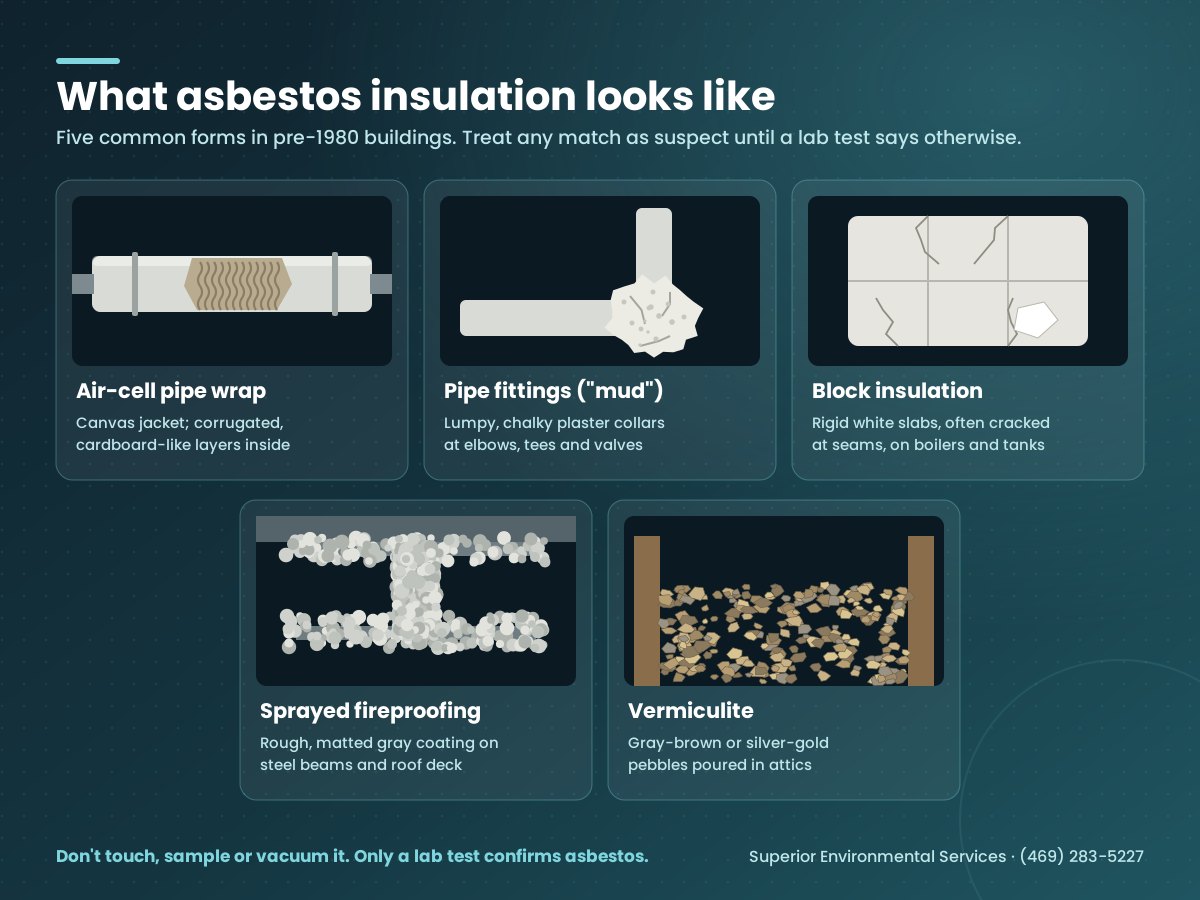
Asbestos insulation comes in five common forms. Each looks different: corrugated gray-white pipe wrap, chalky plaster-like elbows on pipe fittings, rigid white block on boilers and tanks, rough gray spray-on fireproofing, and pebbly gray-brown or silver-gold vermiculite in attics. The catch is that none of them can be confirmed by sight. This guide shows you what to look for and where it hides in Dallas–Fort Worth buildings, and how to get a definite answer without disturbing it.

Identification chart showing what the five types of asbestos insulation look like: pipe wrap, pipe fittings, block insulation, sprayed fireproofing and vermiculite
The five forms of asbestos insulation. A lab test is the only way to confirm any of them.

Asbestos insulation identification chart

Use this to narrow down what you’re looking at. Anything that matches and was installed before about 1980 should be treated as asbestos-containing until a lab says otherwise.

Type What it looks like Where you’ll find it Risk if damaged
Air-cell pipe wrap White or gray canvas jacket; ridged, cardboard-like corrugated layers where it’s torn Hot water and steam lines, mechanical rooms, older commercial buildings High (friable)
Pipe fittings (“mud”) Lumpy, chalky white or gray plaster collars at elbows, tees and valves Wherever wrapped pipe turns or meets a valve High; often cracks first
Block insulation Rigid white to light-gray slabs, usually under a cement or canvas skin with cracks at the seams Boilers, furnaces, tanks, breeching High when cracked
Sprayed-on fireproofing Rough, matted gray or off-white layer, somewhere between cotton candy and stucco Structural steel and deck above ceiling tiles in commercial and multifamily buildings High (friable)
Vermiculite Loose, lightweight pebbles, gray-brown or silver-gold, from grains up to about an inch Attics and some wall cavities, poured between joists High when disturbed

The short version

Don’t touch it, sample it yourself or vacuum it. If it’s intact, leave it alone. If it’s damaged, close off the area and have it tested. Asbestos testing is the only way to know.

What does asbestos pipe insulation look like?

Pipe insulation is the most recognizable form, and it comes in two parts that often test differently.

Corrugated air-cell pipe wrap

Layers of corrugated paper wrapped around a pipe and finished with a white or gray canvas jacket, which is sometimes painted. Where the jacket is torn, the corrugation shows as a ridged pattern, grayish white or tan with age, a lot like the inside of a cardboard box. It was standard on steam and hot water lines, and it grows fragile as it ages.

Plaster-like elbows and fittings

Straight wrap won’t bend around a corner, so insulators packed a wet asbestos-containing “mud” into elbows, tees and valves and smoothed it over. Cured, it looks like a lumpy plaster collar, chalky white or gray. These fittings often contain more asbestos than the straight runs and crack more easily. It’s common to find wrap in decent shape with crumbling fittings at every turn.

What does asbestos block insulation look like?

Block insulation comes as rigid, preformed blocks or slabs, white to light gray, fitted around boilers, furnaces, water tanks and large ducts and then covered with a cement coating or canvas. It looks solid and chalky rather than fibrous. Usually all you see is a thick, painted shell with cracks running out from the corners and seams. Where the shell has broken, the block underneath looks like dense, dry chalk or compressed white board.

In DFW you’ll mostly find block insulation in commercial boiler rooms, schools, churches, hospitals and older industrial buildings rather than houses, because most North Texas homes were heated with forced air, not boilers.

What does sprayed-on asbestos fireproofing look like?

Sprayed fireproofing and acoustic surfacing went onto structural steel and the underside of floor and roof decks in commercial and multifamily buildings. It’s a rough, matted layer, gray to off-white, with a lumpy texture somewhere between cotton candy and stucco. Look above the suspended ceiling tiles and in mechanical rooms. That’s where electricians and cable installers damage it without realizing.

Federal OSHA rules treat it, along with pipe and boiler insulation, as presumed asbestos-containing material in buildings built through 1980 until testing proves otherwise. If you manage an older commercial building, our commercial asbestos survey page covers how that gets documented.

What does vermiculite (asbestos attic insulation) look like?

Vermiculite is a mineral that expands into lightweight, accordion-like pellets when it’s heated. Poured into an attic between the joists, it looks like a layer of small pebbles or coarse gravel, gray-brown or silver-gold, with pieces ranging from fine grains up to nearly an inch. It’s lighter than it looks and sometimes glitters in a flashlight beam.

The problem is where it came from. A mine near Libby, Montana supplied most of the vermiculite sold in the United States from 1919 to 1990, and that deposit was contaminated with asbestos. Much of it was sold as Zonolite. Not every bag contained asbestos, but enough did that the EPA’s advice is simple: assume vermiculite attic insulation contains asbestos, leave it undisturbed and don’t store things in that attic.

What does asbestos wall insulation look like?

This is one of the most common questions, and the honest answer is that most walls don’t have it. Asbestos wall insulation usually turns out to be one of three things:

  • Vermiculite poured into wall cavities. The same pebbly gray-brown or silver-gold material as attic vermiculite. It sometimes spills out of outlets or holes in older homes.
  • Insulating board or batts in older commercial walls. Rare in houses, but some older commercial and institutional buildings used asbestos-containing board.
  • Not insulation at all. More often, asbestos in a wall is in the drywall joint compound, wall texture or plaster, not the insulation behind it. In pre-1980 homes, test those before you sand or demo.

What asbestos insulation is not

Pink or yellow fiberglass batts aren’t asbestos. Neither is blown-in cellulose (gray, shredded paper), mineral wool, rock wool or spray foam. But the presence of one doesn’t rule out the others. Newer insulation is often installed right on top of older material, and a modern batt next to a boiler says nothing about what’s under the boiler jacket.

If it looks like… It’s probably… Asbestos concern?
Pink, yellow or white fluffy batts with a paper or foil face Fiberglass No, but check what’s under it
Gray, shredded paper blown loose Cellulose No
Gray-brown or silver-gold pebbles Vermiculite Yes, assume it is
Corrugated wrap or plaster collars on pipes Air-cell wrap and fitting mud Yes, if pre-1980
Rigid chalky slabs on a boiler or tank Block insulation Yes, if pre-1980

Where asbestos insulation hides in DFW buildings

North Texas houses mostly use forced-air systems, so boiler and steam-pipe insulation is less common here than in older Northern cities. Where it does show up:

  • Attics of pre-1980 homes: vermiculite between the joists, plus asbestos-containing duct wrap and tape on older HVAC.
  • Older Dallas and Fort Worth neighborhoods: about half of Dallas housing predates 1980, and houses with original hydronic heat or water heater closets can still have pipe wrap.
  • Commercial buildings, schools and churches: pipe and boiler insulation in mechanical rooms, sprayed fireproofing above ceilings.
  • Older multifamily: pipe chases and mechanical rooms, sometimes behind drywall added later.

Condition matters more than type

Once a material is presumed or confirmed to contain asbestos, the useful question is what shape it’s in. Fibers are released when the material is disturbed or damaged. Intact, sealed material that’s left alone generally isn’t releasing anything.

Good condition means an unbroken jacket, no cracking or crumbling, no dust or debris on surfaces below and no water staining. Insulation like that is often best managed in place, because removing it disturbs it.

Faster action is warranted with torn jacketing, crumbling fittings, powder or chunks on the floor, water damage from a roof or pipe leak, or a past renovation that cut into insulation without controls. Finding damaged insulation doesn’t mean harm has occurred. It means the material should be evaluated and stabilized or removed under controls, with people kept out of the area in the meantime.

Don’t investigate it yourself

The natural impulse is to get closer, peel back a corner of the jacket or break off a piece. Each of those does exactly what you’re trying to prevent. Don’t touch, poke, cut, sweep or vacuum suspect insulation, and don’t take your own sample. Household vacuums pass the fine fibers straight through. If material is damaged, close the door, keep people and pets out, and shut off any HVAC system that pulls air from that space.

How testing gives you a definite answer

A lab is the only way to know. Bulk samples are taken under controls (the material is wetted, the area isolated and each sample sealed) and analyzed by polarized light microscopy at an accredited laboratory. The analysis shows whether asbestos is present, which type, and roughly what share of the material it makes up. Each distinct material should be sampled separately, since pipe wrap and its fittings can come back different.

Our asbestos testing service handles sampling and accredited lab analysis, and our guide to asbestos testing costs in DFW lays out typical industry ranges. For the bigger picture across all building materials, see what asbestos looks like.

If the insulation has to come out

Asbestos abatement is a controlled process, not a demolition job. The work area is sealed and put under negative air pressure, the material is wetted and removed without breaking it up more than necessary, and the waste goes to a permitted facility. The job closes with verification: clearance air testing confirms the area is safe before anyone goes back in.

Not sure what’s in your attic or mechanical room?

Superior Environmental Services is a licensed, insured team based in Plano, serving Dallas, Tarrant, Collin and Denton counties. We sample under controls, use accredited labs and can usually be on site within 24 hours.

Call (469) 283-5227

Frequently asked questions

Can you tell if insulation has asbestos just by looking at it?

No. Appearance can tell you a material is suspect, like corrugated pipe wrap, plaster-like fittings or vermiculite, but only laboratory analysis can confirm asbestos. Treat suspect insulation in a building from before about 1980 as asbestos-containing until it’s tested.

What color is asbestos insulation?

Most asbestos pipe, block and sprayed insulation is white, off-white or gray, sometimes painted or yellowed with age. Vermiculite is gray-brown or silver-gold. Color doesn’t confirm or rule out asbestos.

Is all vermiculite insulation asbestos?

Not all of it, but much of the vermiculite sold in the U.S. before 1990 came from a mine contaminated with asbestos. The EPA recommends assuming vermiculite attic insulation contains asbestos and leaving it undisturbed unless it’s tested or removed by professionals.

Is asbestos insulation dangerous if I leave it alone?

Intact, undamaged asbestos insulation that isn’t disturbed generally doesn’t release fibers. The risk comes from damage, deterioration or disturbance during repairs and renovation. That’s why condition, not just presence, decides what to do.

How much does it cost to test insulation for asbestos?

Across the industry, testing one or two suspect materials typically runs about $250 to $600, depending on the number of samples and how fast you need results. Those are industry averages, not our quotes. To get a real quote, contact our team.