
What Does Asbestos Insulation Look Like? (ID Chart by Type)

Asbestos insulation comes in five common forms. Each looks different: corrugated gray-white pipe wrap, chalky plaster-like elbows on pipe fittings, rigid white block on boilers and tanks, rough gray spray-on fireproofing, and pebbly gray-brown or silver-gold vermiculite in attics. The catch is that none of them can be confirmed by sight. This guide shows you what to look for and where it hides in Dallas–Fort Worth buildings, and how to get a definite answer without disturbing it.
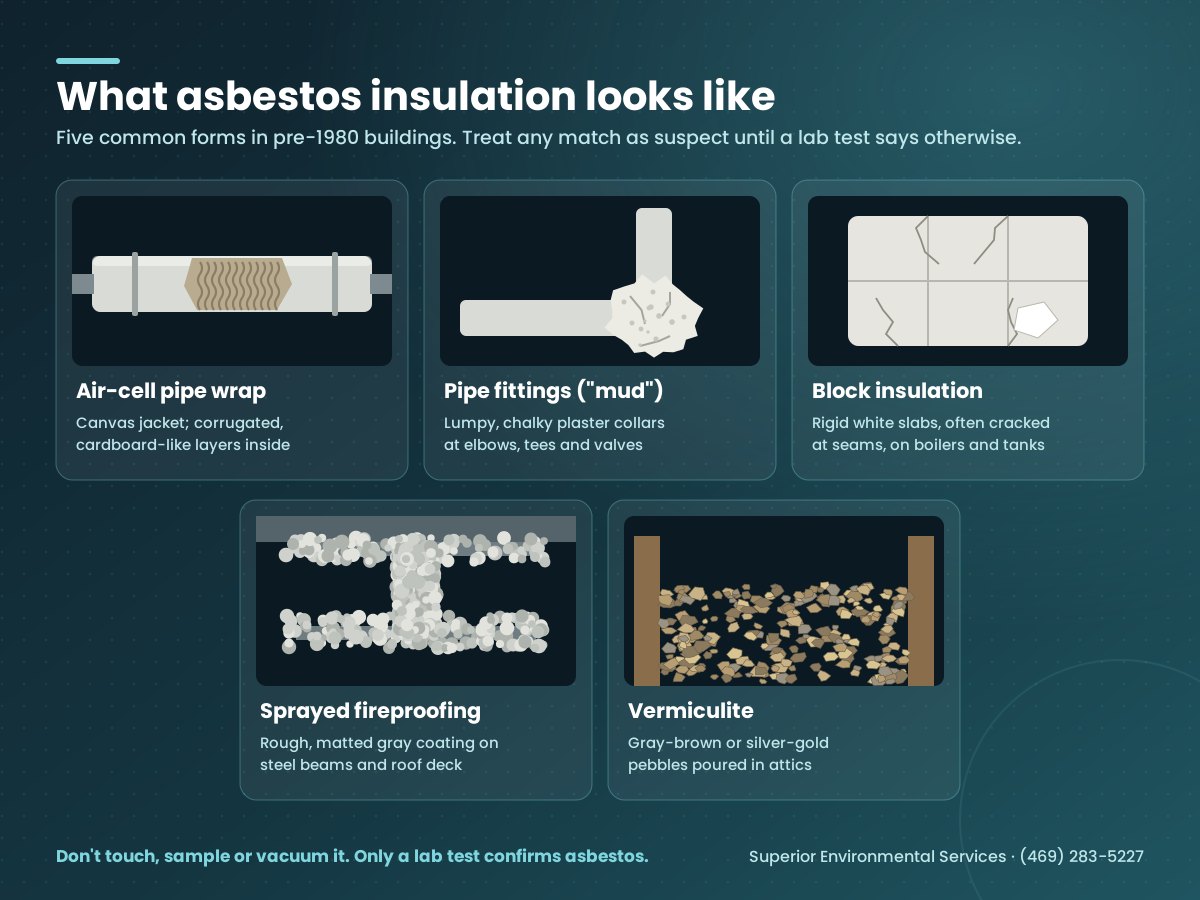
Identification chart showing what the five types of asbestos insulation look like: pipe wrap, pipe fittings, block insulation, sprayed fireproofing and vermiculite
The five forms of asbestos insulation. A lab test is the only way to confirm any of them.

Asbestos insulation identification chart

Use this to narrow down what you’re looking at. Anything that matches and was installed before about 1980 should be treated as asbestos-containing until a lab says otherwise.

Type What it looks like Where you’ll find it Risk if damaged
Air-cell pipe wrap White or gray canvas jacket; ridged, cardboard-like corrugated layers where it’s torn Hot water and steam lines, mechanical rooms, older commercial buildings High (friable)
Pipe fittings (“mud”) Lumpy, chalky white or gray plaster collars at elbows, tees and valves Wherever wrapped pipe turns or meets a valve High; often cracks first
Block insulation Rigid white to light-gray slabs, usually under a cement or canvas skin with cracks at the seams Boilers, furnaces, tanks, breeching High when cracked
Sprayed-on fireproofing Rough, matted gray or off-white layer, somewhere between cotton candy and stucco Structural steel and deck above ceiling tiles in commercial and multifamily buildings High (friable)
Vermiculite Loose, lightweight pebbles, gray-brown or silver-gold, from grains up to about an inch Attics and some wall cavities, poured between joists High when disturbed

The short version

Don’t touch it, sample it yourself or vacuum it. If it’s intact, leave it alone. If it’s damaged, close off the area and have it tested. Asbestos testing is the only way to know.

What does asbestos pipe insulation look like?

Pipe insulation is the most recognizable form, and it comes in two parts that often test differently.

Corrugated air-cell pipe wrap

Layers of corrugated paper wrapped around a pipe and finished with a white or gray canvas jacket, which is sometimes painted. Where the jacket is torn, the corrugation shows as a ridged pattern, grayish white or tan with age, a lot like the inside of a cardboard box. It was standard on steam and hot water lines, and it grows fragile as it ages.

Plaster-like elbows and fittings

Straight wrap won’t bend around a corner, so insulators packed a wet asbestos-containing “mud” into elbows, tees and valves and smoothed it over. Cured, it looks like a lumpy plaster collar, chalky white or gray. These fittings often contain more asbestos than the straight runs and crack more easily. It’s common to find wrap in decent shape with crumbling fittings at every turn.

What does asbestos block insulation look like?

Block insulation comes as rigid, preformed blocks or slabs, white to light gray, fitted around boilers, furnaces, water tanks and large ducts and then covered with a cement coating or canvas. It looks solid and chalky rather than fibrous. Usually all you see is a thick, painted shell with cracks running out from the corners and seams. Where the shell has broken, the block underneath looks like dense, dry chalk or compressed white board.

In DFW you’ll mostly find block insulation in commercial boiler rooms, schools, churches, hospitals and older industrial buildings rather than houses, because most North Texas homes were heated with forced air, not boilers.

What does sprayed-on asbestos fireproofing look like?

Sprayed fireproofing and acoustic surfacing went onto structural steel and the underside of floor and roof decks in commercial and multifamily buildings. It’s a rough, matted layer, gray to off-white, with a lumpy texture somewhere between cotton candy and stucco. Look above the suspended ceiling tiles and in mechanical rooms. That’s where electricians and cable installers damage it without realizing.

Federal OSHA rules treat it, along with pipe and boiler insulation, as presumed asbestos-containing material in buildings built through 1980 until testing proves otherwise. If you manage an older commercial building, our commercial asbestos survey page covers how that gets documented.

What does vermiculite (asbestos attic insulation) look like?

Vermiculite is a mineral that expands into lightweight, accordion-like pellets when it’s heated. Poured into an attic between the joists, it looks like a layer of small pebbles or coarse gravel, gray-brown or silver-gold, with pieces ranging from fine grains up to nearly an inch. It’s lighter than it looks and sometimes glitters in a flashlight beam.

The problem is where it came from. A mine near Libby, Montana supplied most of the vermiculite sold in the United States from 1919 to 1990, and that deposit was contaminated with asbestos. Much of it was sold as Zonolite. Not every bag contained asbestos, but enough did that the EPA’s advice is simple: assume vermiculite attic insulation contains asbestos, leave it undisturbed and don’t store things in that attic.

What does asbestos wall insulation look like?

This is one of the most common questions, and the honest answer is that most walls don’t have it. Asbestos wall insulation usually turns out to be one of three things:

  • Vermiculite poured into wall cavities. The same pebbly gray-brown or silver-gold material as attic vermiculite. It sometimes spills out of outlets or holes in older homes.
  • Insulating board or batts in older commercial walls. Rare in houses, but some older commercial and institutional buildings used asbestos-containing board.
  • Not insulation at all. More often, asbestos in a wall is in the drywall joint compound, wall texture or plaster, not the insulation behind it. In pre-1980 homes, test those before you sand or demo.

What asbestos insulation is not

Pink or yellow fiberglass batts aren’t asbestos. Neither is blown-in cellulose (gray, shredded paper), mineral wool, rock wool or spray foam. But the presence of one doesn’t rule out the others. Newer insulation is often installed right on top of older material, and a modern batt next to a boiler says nothing about what’s under the boiler jacket.

If it looks like… It’s probably… Asbestos concern?
Pink, yellow or white fluffy batts with a paper or foil face Fiberglass No, but check what’s under it
Gray, shredded paper blown loose Cellulose No
Gray-brown or silver-gold pebbles Vermiculite Yes, assume it is
Corrugated wrap or plaster collars on pipes Air-cell wrap and fitting mud Yes, if pre-1980
Rigid chalky slabs on a boiler or tank Block insulation Yes, if pre-1980

Where asbestos insulation hides in DFW buildings

North Texas houses mostly use forced-air systems, so boiler and steam-pipe insulation is less common here than in older Northern cities. Where it does show up:

  • Attics of pre-1980 homes: vermiculite between the joists, plus asbestos-containing duct wrap and tape on older HVAC.
  • Older Dallas and Fort Worth neighborhoods: about half of Dallas housing predates 1980, and houses with original hydronic heat or water heater closets can still have pipe wrap.
  • Commercial buildings, schools and churches: pipe and boiler insulation in mechanical rooms, sprayed fireproofing above ceilings.
  • Older multifamily: pipe chases and mechanical rooms, sometimes behind drywall added later.

Condition matters more than type

Once a material is presumed or confirmed to contain asbestos, the useful question is what shape it’s in. Fibers are released when the material is disturbed or damaged. Intact, sealed material that’s left alone generally isn’t releasing anything.

Good condition means an unbroken jacket, no cracking or crumbling, no dust or debris on surfaces below and no water staining. Insulation like that is often best managed in place, because removing it disturbs it.

Faster action is warranted with torn jacketing, crumbling fittings, powder or chunks on the floor, water damage from a roof or pipe leak, or a past renovation that cut into insulation without controls. Finding damaged insulation doesn’t mean harm has occurred. It means the material should be evaluated and stabilized or removed under controls, with people kept out of the area in the meantime.

Don’t investigate it yourself

The natural impulse is to get closer, peel back a corner of the jacket or break off a piece. Each of those does exactly what you’re trying to prevent. Don’t touch, poke, cut, sweep or vacuum suspect insulation, and don’t take your own sample. Household vacuums pass the fine fibers straight through. If material is damaged, close the door, keep people and pets out, and shut off any HVAC system that pulls air from that space.

How testing gives you a definite answer

A lab is the only way to know. Bulk samples are taken under controls (the material is wetted, the area isolated and each sample sealed) and analyzed by polarized light microscopy at an accredited laboratory. The analysis shows whether asbestos is present, which type, and roughly what share of the material it makes up. Each distinct material should be sampled separately, since pipe wrap and its fittings can come back different.

Our asbestos testing service handles sampling and accredited lab analysis, and our guide to asbestos testing costs in DFW lays out typical industry ranges. For the bigger picture across all building materials, see what asbestos looks like.

If the insulation has to come out

Asbestos abatement is a controlled process, not a demolition job. The work area is sealed and put under negative air pressure, the material is wetted and removed without breaking it up more than necessary, and the waste goes to a permitted facility. The job closes with verification: clearance air testing confirms the area is safe before anyone goes back in.

Not sure what’s in your attic or mechanical room?

Superior Environmental Services is a licensed, insured team based in Plano, serving Dallas, Tarrant, Collin and Denton counties. We sample under controls, use accredited labs and can usually be on site within 24 hours.

Call (469) 283-5227

Frequently asked questions

Can you tell if insulation has asbestos just by looking at it?

No. Appearance can tell you a material is suspect, like corrugated pipe wrap, plaster-like fittings or vermiculite, but only laboratory analysis can confirm asbestos. Treat suspect insulation in a building from before about 1980 as asbestos-containing until it’s tested.

What color is asbestos insulation?

Most asbestos pipe, block and sprayed insulation is white, off-white or gray, sometimes painted or yellowed with age. Vermiculite is gray-brown or silver-gold. Color doesn’t confirm or rule out asbestos.

Is all vermiculite insulation asbestos?

Not all of it, but much of the vermiculite sold in the U.S. before 1990 came from a mine contaminated with asbestos. The EPA recommends assuming vermiculite attic insulation contains asbestos and leaving it undisturbed unless it’s tested or removed by professionals.

Is asbestos insulation dangerous if I leave it alone?

Intact, undamaged asbestos insulation that isn’t disturbed generally doesn’t release fibers. The risk comes from damage, deterioration or disturbance during repairs and renovation. That’s why condition, not just presence, decides what to do.

How much does it cost to test insulation for asbestos?

Across the industry, testing one or two suspect materials typically runs about $250 to $600, depending on the number of samples and how fast you need results. Those are industry averages, not our quotes. To get a real quote, contact our team.


Asbestos in Commercial Buildings: What DFW Property Managers Need to Know

Most writing about asbestos is aimed at someone who just found it and wants it gone. That is rarely your situation. If you manage commercial property in the Dallas-Fort Worth metroplex and the building went up before the mid-1980s, the real question is how to run it for years without anyone getting hurt and without a routine service call becoming a regulatory problem. That is an ongoing duty.

With no survey on file, the regulation assumes an answer

OSHA’s construction standard, 29 CFR 1926.1101, defines Presumed Asbestos Containing Material — PACM — as thermal system insulation and surfacing material found in buildings constructed no later than 1980: pipe and boiler insulation, sprayed-on and troweled-on fireproofing, acoustic plaster. Absent a survey, those materials are asbestos as far as OSHA is concerned. The general industry standard at 29 CFR 1910.1001 extends comparable treatment to asphalt and vinyl flooring installed no later than 1980.

The presumption is rebuttable, but only on evidence: under 1926.1101(k)(5), an inspection conducted under AHERA requirements, or bulk sampling by an accredited inspector or certified industrial hygienist analyzed by a proficient laboratory. That is what asbestos testing is for, and why we use accredited laboratories.

Managing it in place is usually the right call, and the cheaper one

Property managers often assume the responsible move is removal. EPA says otherwise. In Managing Asbestos in Place, it states that “removal is often not a building owner’s best course of action to reduce asbestos exposure. In fact, an improper removal can create a dangerous situation where none previously existed.” EPA requires removal principally to prevent significant public exposure during demolition or renovation, and otherwise recommends proactive in-place management.

Intact material in good condition is not releasing fibers, and tearing it out is the most reliable way to put fibers into the air. Full removal in an occupied multi-story building typically runs into the tens of thousands of dollars and up; in-place management usually costs a fraction of that per year. Removal earns its keep when material is damaged, keeps getting disturbed, or is in the path of a renovation anyway. Our commercial asbestos team will tell you which situation you are in, and you will have the scope and cost in writing before any work begins.

What an O&M program actually involves

EPA describes an operations and maintenance program as “a formulated plan of training, cleaning, work practices, and surveillance to maintain asbestos-containing materials within buildings in good condition.” For an owner, that means:

  • A current inventory with condition ratings — every homogeneous area of known or presumed material, where it is and what shape it is in.
  • Written work practices for anything that could contact it, from changing a ceiling tile to pulling cable above a corridor.
  • Trained in-house staff, with awareness training suited to what they may contact.
  • Periodic surveillance, so degradation is documented before it becomes an exposure event.
  • Cleaning and response protocols for debris, water damage above suspect material, and small releases.
  • A named responsible person. If nobody owns the program, it does not exist.

Texas adds to that. Under 25 TAC 296.191, a public building owner must develop a management plan to control asbestos-containing material during operations and maintenance, renovation and demolition, and must use a licensed O&M contractor for small-scale, short-duration O&M activity or cleanup affecting asbestos. That category is genuinely small — the rule ties it to work fitting in a single standard 60-inch by 60-inch glove bag or one prefabricated mini-containment. Past that, it is a project. Periodic air quality testing shows the program is working rather than merely written.

The duty to tell people before they open a ceiling

This requirement is missed most often, and it sits squarely on the owner. Under 1926.1101(k)(2)(i), before work subject to the standard begins, building and facility owners must determine the presence, location and quantity of asbestos-containing and presumed asbestos-containing material at the work site. Under (k)(2)(ii), they must then notify:

  • Prospective employers bidding for work whose employees can reasonably be expected to work in or adjacent to areas containing the material
  • The owner’s own employees who will work in or adjacent to those areas
  • On multi-employer worksites, all employers of employees performing work within or adjacent to those areas
  • Tenants who will occupy areas containing the material

Notification may be in writing or a personal communication. Put it in writing anyway — a verbal warning to a subcontractor’s foreman is worth nothing eighteen months later. The general industry standard also requires owners to keep records of the material’s presence, location and quantity for the duration of ownership and transfer them to successive owners.

When nobody warned the HVAC tech

A plumber cuts into a chase and pulls out thirty-year-old pipe wrap. An electrician drills through a fireproofed beam. Nobody told them, so nobody took precautions. OSHA classifies repair and maintenance where asbestos-containing material is likely to be disturbed as Class III work, with its own control requirements. Done unprotected, it leaves you with a contaminated area, occupants who were in it, workers with no exposure assessment, and a cleanup that must be handled by licensed people — almost always costlier than the notification would have been.

If it has already happened, treat it as urgent. Stop work, restrict the area, and do not let anyone sweep or vacuum. We are reachable 24/7/365 and can have licensed, insured, certified technicians on site within 24 hours to assess, contain and handle the abatement and cleanup, with air clearance sampling before the space is reoccupied.

Where a tenant fit-out becomes regulated asbestos work

Build-outs cross into regulated territory faster than most people expect. Under 25 TAC 296.191(d), before any renovation or dismantling within or outside a public building, commercial building or facility, the owner must have an asbestos survey performed, covering all immediately surrounding areas that could foreseeably be disturbed. Demising wall moves, ceiling grid changes, flooring replacement and above-ceiling mechanical work all qualify. In public buildings the survey must be done by an appropriately licensed person, or by a Texas-registered architect or licensed engineer certifying from construction documentation that no asbestos is present; in commercial buildings, an accredited inspector with the required training may perform it.

Two thresholds then matter. The asbestos NESHAP at 40 CFR 61.145 requires the affected facility to be thoroughly inspected before demolition or renovation, and its full requirements attach when the regulated asbestos-containing material to be disturbed reaches at least 260 linear feet on pipes, 160 square feet on other facility components, or 35 cubic feet off facility components. Written notification must be postmarked or delivered at least 10 working days before work begins. Texas is stricter for public buildings: under 25 TAC 296.251, DSHS notification is required for any demolition whether or not asbestos has been identified, and for abatement of any amount of asbestos-containing building material, again on 10 working days’ notice. That is roughly two calendar weeks — build it into the schedule rather than finding it the week the tenant expects keys. A pre-demolition or pre-renovation survey keeps that schedule intact, and we can coordinate it with demolition work when a project calls for both.

What belongs in the building file

Assume every document will be read by someone who was not there. A defensible file holds all survey reports with laboratory results, the current management plan and O&M procedures, surveillance logs, staff training records, written notifications to contractors and tenants, DSHS notification forms, abatement documentation with waste manifests, and air clearance results. Texas requires public building owners to keep architect or engineer certifications, safety data sheets and previous asbestos surveys, and requires licensed consultants to retain survey reports, sampling results and management plans for 30 years.

The file earns its keep at sale or refinance, when diligence asks what is in the building, what condition it is in, and what you have done about it. A complete file answers all three in an afternoon. An empty one becomes a re-survey on someone else’s timeline, or a holdback.

Getting a program in place

If you manage a pre-1980 commercial property in Dallas, Tarrant, Collin or Denton county and cannot put your hands on a current survey today, start there. From our Plano office we handle surveys, sampling through accredited laboratories, O&M program development, and abatement when it is warranted. Call (469) 283-5227 to talk through your portfolio, and you will have an itemized written quote covering scope and cost before anyone begins.

What Asbestos Testing Costs in DFW, and What Drives the Price

Almost everyone who calls about asbestos testing opens with the same question: what does it cost. It is a fair question with an annoying answer — it depends, mostly on how many samples you need and how hard they are to reach. Two houses on the same street in Richardson, built the same year, can produce very different numbers because one has popcorn ceiling in three rooms and the other has popcorn ceiling, vinyl tile, and pipe wrap in a crawlspace.

The unit of pricing is the sample, not the house

Most asbestos testing is priced in two parts: a site visit to collect samples, and a per-sample lab fee. Published market ranges put the collection visit in the low hundreds of dollars, with per-sample analysis by polarized light microscopy commonly quoted around $20 to $50 and transmission electron microscopy higher. Homeowners often see full residential testing land between roughly $300 and $900 depending on scope. Treat those as market ranges, not our prices — no responsible company can quote a real figure before knowing what is in the building.

Sample count is the lever that moves everything else. Under the federal AHERA inspection framework, reflected in the Texas rules, a survey requires a minimum of three samples from each homogeneous area — one material that looks the same, was installed at the same time, and is the same throughout. So the question is not how big the house is, but how many distinct suspect materials sit in the work area. A kitchen remodel touching one sheet-vinyl floor is small. A whole-house renovation with texture, tile, mastic, joint compound, and duct insulation is five or six homogeneous areas.

Bulk sampling and air sampling are different products

Bulk sampling answers “is asbestos in this material.” A technician cuts or scrapes a small piece, seals it, and a lab identifies fiber content under a microscope. It is what a pre-renovation survey is built on.

Air sampling answers a different question: how many fibers are in this air right now. It monitors containment during abatement and clears the job at the end, and it is priced by pump-hours and cassettes rather than by material. A clearance on one small containment is one thing; a multi-day project with perimeter monitoring is another. Market ranges for air testing run from a few hundred dollars to roughly $1,200.

Texas sets the clearance bar explicitly. Under the Texas Asbestos Health Protection Rules administered by DSHS, clearance follows a sequence — visual inspection, air clearance sampling, containment removal, final visual inspection — and is achieved only if no sample is reported greater than 0.01 fibers per cubic centimeter by a licensed laboratory, using NIOSH Method 7400 phase-contrast microscopy or a transmission electron microscopy protocol. That is a pass-fail threshold with a number attached, which is why clearance sampling is not the place to economize.

Turnaround is a real line item, and usually the wrong thing to buy

Standard lab turnaround is typically a few business days. Rush analysis exists and costs more, commonly a surcharge in the tens to low hundreds of dollars per sample. But plan around this: Texas requires notification to DSHS no less than 10 working days — working days, not calendar days — before demolition or asbestos abatement begins, and the federal NESHAP rule carries the same 10-working-day written notice requirement. Notification is required before a demolition even when no asbestos is present. If your survey is not done, that clock has not started. Testing early is cheaper than testing fast.

Access is the quiet cost driver

A ceiling sample from a step ladder takes minutes. Pipe insulation in a tight attic in August, boiler insulation behind equipment, roofing three stories up, or material under a finished floor that must be opened and patched — those take time, sometimes equipment, sometimes a second person. Occupied buildings add a layer: after-hours work in a leased office costs more than an empty building on a Tuesday morning.

A single sample versus a full survey

A homeowner who wants one popcorn ceiling checked before a texture scrape needs a handful of samples and a lab report — a legitimate, limited scope. A pre-demolition survey is comprehensive by design. The federal NESHAP rule requires a thorough inspection of the affected facility for asbestos, including Category I and Category II nonfriable material, before demolition or renovation begins, and Texas rules require the survey to cover the work area and all surrounding areas that could foreseeably be disturbed. Before demolition, that means the whole building, and a pre-demolition survey in Dallas is priced accordingly. Buying a two-sample test and calling it a demolition survey does not satisfy the rule, and a contractor who accepts one is exposed, not protected.

The cheapest lab is often not the cheapest outcome

Two things go wrong with bargain testing. The first is undersampling — one sample where the framework calls for three per homogeneous area, or materials skipped because they were not obvious on a walkthrough. When a survey misses a material, you find it mid-demolition, work stops, and you re-test and re-notify on someone else’s schedule.

The second is a failed clearance. Above 0.01 f/cc, containment stays up, the crew re-cleans, and you pay for another round of sampling. One re-test plus a day of idle crew erases whatever you saved per sample, several times over.

What the report actually gets you

A survey report is the document that lets a project legally proceed:

  • It satisfies the inspection requirement. NESHAP requires the thorough inspection before work starts, and Texas requires a survey by a licensed inspector before renovation or demolition in public and commercial buildings.
  • It supports your notification. The DSHS form asks what was found and in what quantity. Those answers come from the survey.
  • It rebuts the OSHA presumption. Under the OSHA construction standard, thermal system insulation and surfacing material in buildings built no later than 1980 are presumed to contain asbestos. Negative data rebuts that presumption, and the owner must keep it as long as it is relied on. Without it, your crew works to Class I or Class II requirements by default.
  • It follows the building. Texas requires owners to keep survey records, and buyers, lenders, and tenants ask for them.

When testing stops being optional

For most single-family homes with four or fewer dwelling units, federal demolition and renovation requirements do not apply the way they do to commercial property. That exemption narrows fast — it does not hold when a residence comes down as part of a larger project, and it never makes disturbing asbestos safe.

Testing is not optional when you are demolishing a building of any kind, renovating a public or commercial building in Texas, disturbing regulated asbestos-containing material at or above the NESHAP thresholds of 260 linear feet on pipes, 160 square feet on other facility components, or 35 cubic feet where area cannot be measured, or a permit desk asks for a survey. For commercial and public buildings across the metroplex, assume a survey is required and work backward from your notification date.

If results come back positive, the next conversation is scope — whether the material can be managed in place, encapsulated, or removed. Abatement carries its own notification, containment, and clearance requirements, and should be quoted separately from the testing that found it.

Getting a real number for your project

Pricing this honestly means knowing how many homogeneous areas are in play, whether you need bulk sampling, air sampling, or both, how fast you need results, and how accessible the materials are. Tell us the building’s age, the scope of work, and your deadline, and we will put together an itemized written quote breaking out the site visit, sample count, analysis method, and turnaround — the scope and cost in writing before any work begins.

Superior Environmental Services is licensed and insured, with certified technicians, an office in Plano, and service throughout Dallas, Tarrant, Collin, and Denton counties. We are available 24/7/365, can be on site within 24 hours, and send samples to accredited laboratories. Call (469) 283-5227 to talk through your project.

Do You Need an Asbestos Survey Before Demolition in Texas?

Short answer: almost certainly yes, and the requirement does not depend on whether you think the building has asbestos in it. That last part is where schedules get wrecked. A 2004 metal warehouse in Garland feels like a safe assumption right up until a Texas Department of State Health Services inspector asks for the survey report.

What the federal asbestos NESHAP requires

The governing federal rule is the asbestos NESHAP at 40 CFR Part 61, Subpart M. Under 40 CFR 61.145(a), the owner or operator must “thoroughly inspect the affected facility” for asbestos, “including Category I and Category II nonfriable ACM,” before demolition or renovation begins.

The inspection is not conditional. There is no exemption for buildings you believe are clean, none for post-1980 construction, and none for a prior survey that did not cover the whole building. Roofing, mastics, floor tile, joint compound and gaskets turn up in buildings far newer than contractors expect.

Notification is a separate obligation. Even when the survey comes back clean, 40 CFR 61.145(b) requires written notice of a demolition at least 10 working days out. The removal thresholds — 260 linear feet of regulated asbestos-containing material on pipes, 160 square feet on other components, 35 cubic feet where neither can be measured — govern renovations. For a demolition, notice is required regardless of quantity.

The Texas layer: DSHS and the 10-working-day window

Texas runs its own program through the Texas Asbestos Health Protection Rules at 25 TAC Chapter 296. Two provisions do most of the work.

25 TAC 296.191(d) is the mandatory survey rule: before any renovation or dismantling in a public building, commercial building or facility, “including preparations for partial or complete demolition, the owner must have an asbestos survey performed.” Subsection (e) adds the detail people miss — a limited survey of one work area will not do, because “a comprehensive asbestos survey covering the entire building is required.”

25 TAC 296.251 is the notification rule. Notice must reach DSHS “no fewer than 10 working days before commencement of the activity,” and DSHS must be notified of any demolition of a public building or facility “whether or not asbestos has been identified.” One filing satisfies both the state and the NESHAP obligation. Working days, not calendar days — ten of them across a holiday week is closer to three calendar weeks.

One amendment rule belongs on your calendar: if a start date moves earlier, the amended notification is due at least 10 working days before the new date. You cannot pull a demo forward on short notice, which is exactly what a tenant vacating early tempts you to do.

On licensing, a public building survey must be performed by a licensed asbestos inspector working for a licensed consultant or management planner agency, and showing that no asbestos is present takes at least three samples per suspect homogeneous area. In a commercial building, a MAP-accredited inspector may perform it.

Owner or demolition contractor: who is liable?

Under 25 TAC 296.191, the survey obligation sits with the owner. Commercial building and facility owners must each have a thorough inspection performed before demolition, and hiring a property manager or a general contractor does not shed that duty.

Notification splits differently. For public buildings, 296.251(b)(1) lets the owner delegate filing to an agent — an abatement contractor, consultant or demolition contractor — but the delegation and the agent’s name must appear on the form, and both “are responsible for the accuracy and timeliness of the notification and one or both may be found in violation.” For facilities the duty rests with the owner or operator.

Federal law reaches further: NESHAP duties attach to the “owner or operator,” which EPA reads to include demolition contractors in control of the work. For a GC, pointing at the owner is not a defense. Name the survey in the contract, name the delegated agent on the form, and keep the report and filing confirmation in your own project file. If you are handling the takedown too, scope the demolition work and the survey together.

What happens if you skip it

DSHS may impose an administrative penalty of up to $10,000 per day, per violation under 25 TAC 296.318, and each day of a continuing violation can be counted separately. Its penalty matrix treats failure to conduct a thorough inspection and failure to notify as distinct citable violations, escalating for repeat occurrences, with license suspension or revocation at the upper tiers.

Federal exposure is larger. Asbestos NESHAP violations are Clean Air Act violations, and EPA’s civil penalty maximum under Section 113 is adjusted for inflation annually — it currently exceeds $120,000 per day, per violation. Knowing violations that put another person in imminent danger of death or serious bodily injury carry criminal liability.

The fines are rarely the worst of it. A stop-work order, a debris pile that has to go out as asbestos waste because it was commingled, and a delayed certificate of occupancy usually cost more. Commercial surveys generally run between several hundred and several thousand dollars depending on square footage, building age and the number of homogeneous areas — and you will have the scope and cost in writing first.

How residential differs from commercial

The NESHAP definition of “facility” at 40 CFR 61.141 excludes “residential buildings having four or fewer dwelling units.” An owner-occupied single-family home demolished on its own generally sits outside NESHAP and outside the Texas survey and notification requirements. OSHA worker-protection rules still apply to anyone doing the work for hire, and local ordinances may add conditions.

The exclusion is narrower than it sounds, and this is where residential developers get caught. EPA’s 1995 clarification of intent is explicit: when more than one small residential building on the same site is demolished by the same owner or operator, the exclusion does not apply. Neither does it apply when homes come down as part of a larger commercial or public project — EPA names urban renewal, highway construction and shopping malls.

So a single ranch-house teardown is one thing. A builder taking six lots on the same block, or clearing a residential parcel for a retail pad site, is a NESHAP demolition with full obligations. If you are unsure which side of the line you are on, settle it with sampling and lab analysis before the excavator is scheduled.

Where the survey belongs in your permit timeline

Local permitting already assumes you have done this. The City of Dallas demolition permit checklist makes the applicant confirm that “an asbestos survey has been conducted in accordance with the Texas Asbestos Health Protection Rules and the National Emission Standards for Hazardous Air Pollutants.” Sequence it backward from your demo date:

  • Survey fieldwork and lab turnaround — every suspect homogeneous area sampled, analyzed by an accredited laboratory.
  • Survey report in hand — what your permit application and your notification both depend on.
  • DSHS notification filed — the 10-working-day clock starts here, not at survey kickoff.
  • Abatement, if regulated material is found — licensed removal and clearance before the structure comes down.
  • Demolition permit and mobilization.

If the survey finds regulated material, add the abatement window to that chain, and note that a notification covering both abatement and demolition is due 10 working days before whichever start date comes first. While you are planning the takedown, check whether the concrete and masonry work triggers respirable silica exposure monitoring — cheapest bundled into the same site visit.

Across DFW, the survey is almost never the real constraint. Starting it late is. Book the pre-demolition asbestos survey when you start the permit application and the report, the notification and the permit tend to land together. Treat it as a permit-desk formality and you find the 10-working-day window on the morning you wanted to mobilize.

Getting it off your critical path

Superior Environmental Services is a licensed and insured environmental remediation company with an office in Plano, serving Dallas, Tarrant, Collin and Denton counties. Our certified technicians perform pre-demolition surveys, samples go to accredited laboratories, and we are available 24/7/365 and able to be on site within 24 hours when a schedule tightens.

If you have a demolition date on a calendar, start with our pre-demolition asbestos survey service or call (469) 283-5227. Give us the date and we will work the survey, the report and the DSHS notification backward from it — and you will have the scope and cost in writing before any work begins.

Asbestos in Popcorn Ceilings: What to Know Before You Scrape

You bought a house in Richardson with a bumpy white ceiling in every bedroom, or you got tired of the one in the Garland ranch. Somebody told you a garden sprayer and a putty knife would handle it in a weekend. Somebody else told you never to touch it. Both are working from partial information.

Start with the context that usually gets lost. Asbestos-containing material that is intact and left alone is generally not putting fibers into your air — the Consumer Product Safety Commission’s guidance is that the best thing to do with such material in good condition is usually to leave it alone. The hazard comes from disturbance: sanding, scraping, drilling, demolishing. If your ceiling is smooth and unbroken, the right response is to plan carefully, not to panic.

Why the ceiling was sprayed in the first place

Spray texture hid drywall seams and went up fast — one crew, one hopper gun, a whole house in a day. Asbestos earned its place in the mix because the fibers added strength, resisted cracking, and cost very little. In a spray texture it sits bound in a matrix of paint and joint compound. That binding is why an undisturbed ceiling is comparatively stable, and why breaking it apart changes everything.

The 1977 date that misleads almost everyone

You will read constantly that asbestos in popcorn ceilings was banned in 1977, so a newer home is clear. That does not follow from the actual regulatory history.

  • 1973. EPA, under the Clean Air Act, banned spray-applied surfacing asbestos-containing material for fireproofing and insulating purposes. Decorative texture was not covered.
  • 1977. The Consumer Product Safety Commission issued its final ban on December 2, covering consumer patching compounds containing asbestos. The ban was on manufacture and sale, not on use. Manufacturers had thirty days to stop producing; retailers had a full one hundred eighty days to sell what was already on their shelves.
  • 1978. EPA extended the spray-applied surfacing ban to purposes not already prohibited — which is when decorative texture was actually caught by federal rule.

Hold two of those together. The 1977 rule let retailers sell existing stock for six months, and it never required anyone to discard product already purchased. A contractor with pallets of texture compound in a warehouse in 1978 was under no obligation to discard it.

OSHA reflects this. Under 29 CFR 1926.1101, surfacing material in any building constructed no later than 1980 is classified as Presumed Asbestos Containing Material — the federal working assumption is that it contains asbestos until testing says otherwise. So the practical rule is: if the texture went up before the mid-1980s, treat it as suspect. A 1979 build in Plano, a 1982 build in Arlington — neither is automatically clear.

You cannot tell by looking, and neither can your contractor

There is no visual tell — not the size of the nodules, not the color, not whether it flakes. A painter with thirty years in the trade cannot look at a ceiling and know, and neither can a home inspector or a general contractor. The only way to know is laboratory analysis of a physical sample, normally by polarized light microscopy. A material is regulated as asbestos-containing above one percent by weight, and one percent is far too little to see or guess at. Texture was also mixed in batches and sprayed in passes, so one room can differ from the next, which is why the convention for surfacing material calls for at least three samples from a homogeneous area.

What a sample costs

Costs vary by market and scope, so treat these as ranges rather than quotes. In Dallas-Fort Worth, a professional visit including sample collection and accredited-laboratory analysis commonly lands in the low-to-mid hundreds of dollars. Against the cost of the project you are contemplating, that is not a close call: a sample analyzed by an accredited laboratory is the cheapest step in the sequence and the one that determines every step after it. If you are unsure whether your house warrants a look, the home environmental risk checker is a place to start.

Why DIY scraping is the worst approach

Dry scraping is close to a worst case for fiber release. You are pulverizing a bound material directly overhead, in an enclosed room, with your face underneath. Debris gets tracked through the house, settles into carpet and HVAC returns, and lifts again every time somebody walks past. That is not a one-afternoon exposure — it is a contaminated house.

Wetting it down does not solve this

The garden-sprayer method is better than dry scraping, and that is the whole of the good news. Amended water reduces airborne fiber release; it does not eliminate it. In real abatement, wetting is one control among many, used alongside sealed containment, negative air pressure, HEPA filtration, fitted respirators, and air clearance afterward. Pulling one control out of that system does not make the job safe. Painted-over texture, common across DFW, also resists water — so people spray more, get frustrated, and scrape harder and drier.

Encapsulation versus removal

Encapsulation means sealing the material in place instead of taking it out — a bonding sealant over the texture, or a new layer of drywall fastened through to the framing. Done properly it leaves the asbestos undisturbed behind a barrier, and it is generally less expensive and less disruptive. The trade-offs are real: the material is still there, you disclose it when you sell, and any future work puts somebody back into it.

Removal ends the question. Under controlled conditions, licensed abatement means the work area is sealed off, held under negative air pressure so nothing migrates into the rest of the house, worked wet, and cleaned with HEPA equipment, with waste taken to a facility authorized to accept it. Afterward, clearance air testing verifies the space is fit to reoccupy before containment comes down — without it, you are only assuming the cleanup worked. If a demolition and rebuild is already underway, handling the ceiling at the same time is usually more efficient.

What the rules ask of you versus a contractor you hire

If you do the work yourself

The Texas Asbestos Health Protection Rules, in Title 25 Chapter 296 of the Administrative Code, apply to asbestos-related activities in public buildings, and state licensing is framed around that term. The rules specifically carve a private residence, and a residential building with four or fewer dwelling units, out of that definition. Texas DSHS also states plainly that one private residence is not subject to the asbestos NESHAP regulations and that notification is not required. So a homeowner scraping their own single-family ceiling generally falls outside state licensing and outside federal notification. That is a real exemption.

What it is not is permission. The exemption addresses who needs a license and who files paperwork. It says nothing about whether the work is safe, and it removes none of the physical consequences. It does not exempt the waste either — asbestos debris has to go to a facility authorized to accept it, not your municipal bin or a rented dumpster. It is also narrower than people assume: a fourplex may qualify, a larger apartment property does not.

If you hire someone

The picture changes the moment there is an employer and an employee. OSHA’s construction asbestos standard applies regardless of building type. Removing surfacing material — which is what a textured ceiling is — falls into Class I, OSHA’s most tightly controlled category, carrying requirements for regulated areas, exposure assessment, respiratory protection, decontamination, and training, against a permissible exposure limit of 0.1 fiber per cubic centimeter as an eight-hour time-weighted average. So a crew you hire is held to standards you personally are not, on the same ceiling — a fair argument for why those standards exist.

Why this comes up constantly in DFW

The metroplex expanded across exactly the decades when spray texture was standard. Large sections of Dallas, Richardson, Garland, Irving, and Arlington were built out through the 1960s and 1970s, Plano’s shift from small town to major suburb happened largely in the 1970s and 1980s, and Fort Worth carries a deep inventory of mid-century housing. Add the region’s remodeling habit and you get a lot of people on ladders under ceilings nobody ever tested.

A sensible order of operations

  • Find out when the texture was applied, not just when the house was built. A 1968 house re-textured in 1990 is a different question.
  • If it predates the mid-1980s, get it sampled before any plan hardens around a scrape.
  • If asbestos is present, choose between encapsulation and removal based on the ceiling’s condition.
  • If you remove, use containment, negative air, and clearance testing.
  • Either way, get the scope and the cost in writing before anyone starts.

Superior Environmental Services is based in Plano and works throughout Dallas, Tarrant, Collin, and Denton counties. Our technicians are licensed and certified, we are insured, we use accredited laboratories, and we are available 24/7/365 with the ability to be on site within 24 hours. If you want to know what is in your ceiling before you touch it, call (469) 283-5227. You will have the scope and cost in writing before any work begins.

Dallas Asbestos Removal Services: Rules and Process

Asbestos removal in Dallas is not the same job as asbestos removal in Plano or Frisco, and the reason is in the housing data. Dallas is an old city wearing a new city’s skyline. Much of the building stock inside the city limits went up before anyone regulated asbestos at all, so the odds that a renovation, a tenant finish-out or a teardown runs into asbestos-containing material are far higher here than a few miles up the tollway.

Here is what makes Dallas different, where asbestos turns up depending on when a building went up, the permit requirement that catches owners off guard, and what a removal project looks like from first call to final clearance report.

Why Dallas Is a Different Problem Than Its Suburbs

The 2024 American Community Survey, table B25034, counts housing units by the decade they were built. Compare the three cities:

  • Dallas: about 276,526 of 599,962 units built 1979 or earlier — roughly 46 percent
  • Plano: about 22,818 of 120,096 units built 1979 or earlier — roughly 19 percent
  • Frisco: about 2,362 of 86,733 units built 1979 or earlier — roughly 3 percent

Those numbers are a planning input, not a scare tactic. If you own or manage property inside Dallas, the base rate of encountering asbestos on any given project is roughly two and a half times what it is in Plano and more than fifteen times what it is in Frisco. That changes how you budget, how you schedule, and how early a survey has to enter the process. Our Dallas service area page covers how we work across the city and the surrounding counties.

Why 1980 as the dividing line: federal restrictions arrived piecemeal. EPA banned spray-applied asbestos surfacing material for fireproofing and insulating in 1973, and the Consumer Product Safety Commission banned asbestos in wall patching compounds and artificial fireplace embers in 1977. Material already manufactured stayed on shelves and in buildings for years afterward. A 1981 building is not automatically clean, and a 1975 building is not automatically contaminated. The date only tells you how hard to look.

Where Asbestos Turns Up, by Building Era

Built 1939 or Earlier: About 29,417 Dallas Units

Dallas’s oldest layer, including designated historic districts such as Swiss Avenue and Munger Place. Here the asbestos usually sits in the mechanical systems rather than the finishes: pipe insulation and boiler lagging, sometimes under a plaster-like coating. Original plaster can carry it in patching and skim coats. Expect layers, too — a century-old house has often been re-floored three or four times, and the suspect material may be two courses down under newer vinyl.

Built 1940 to 1959: About 27,031 and 62,781 Dallas Units

The postwar boom is where asbestos use widens from mechanical systems into finishes. Common suspects are 9-inch by 9-inch vinyl-asbestos floor tile and the black cutback adhesive under it, asbestos cement siding and roofing shingles, and joint compound. Transite — asbestos cement board — shows up around heaters, in utility rooms and on exteriors.

Built 1960 to 1979: About 72,136 and 85,161 Dallas Units

The single largest block of at-risk Dallas housing, and where commercial and multifamily construction concentrates. Textured ceiling coating, usually called popcorn or acoustic ceiling, is the most familiar suspect. Alongside it: sprayed fireproofing in steel-framed commercial buildings, drywall joint compound throughout, resilient sheet flooring, roofing felts and mastics, HVAC duct wrap, and electrical panel components.

Buildings from the 1980s — another 89,590 Dallas units — are not exempt, because existing inventory kept being installed. If you cannot document what a material is, treat it as suspect until a laboratory says otherwise.

The Dallas Demolition Permit Item That Surprises People

If you are demolishing anything in the City of Dallas, the Planning and Development Department’s demolition permit application checklist includes an item the applicant must check off. It reads:

“An asbestos survey has been conducted in accordance with the Texas Asbestos Health Protection Rules and the National Emission Standards for Hazardous Air Pollutants for the area being renovated and/or demolished.”

Two things about that sentence matter. It sits inside a checklist the applicant certifies, backed by a sworn owner’s affidavit — you are attesting the survey happened, not promising to get to it. And it names two separate bodies of rule, both of which have teeth.

Under the Texas Asbestos Health Protection Rules at 25 TAC 296.191, “Before any renovation or dismantling outside of or within a public building, commercial building, or facility, including preparations for partial or complete demolition, the owner must have an asbestos survey performed.” In a public building that survey must be done by an appropriately licensed person. Under 25 TAC 296.53, a licensed asbestos inspector locates and assesses suspect material, collects bulk samples and develops the survey report — and must be employed by a licensed asbestos consultant agency or management planner agency to survey a public building.

Federal NESHAP rules at 40 CFR 61.145 require the owner or operator to “thoroughly inspect the affected facility or part of the facility where the demolition or renovation operation will occur for the presence of asbestos, including Category I and Category II nonfriable ACM.” Texas DSHS notification is due at least 10 working days before work starts, and a demolition notification is required even when no asbestos is present. Work-practice standards begin at 260 linear feet of regulated asbestos-containing material on pipes, 160 square feet on other components, or 35 cubic feet where length and area cannot be measured.

The takeaway: the survey is the first box before demolition, not the last. Booking a demolition survey in Dallas early keeps the 10-working-day clock from becoming the thing that delays your project.

What a Removal Project Actually Looks Like

1. Survey and Sampling

A licensed inspector walks the scope, identifies homogeneous areas of suspect material, and collects bulk samples for analysis by an accredited laboratory. For how sampling and lab analysis work, see what an asbestos testing service actually does.

2. Scope, Written Quote and Notification

Once results are back, the positive materials, their quantities and their condition define the abatement scope. You get the scope and the cost in writing before any work begins. Where the project crosses the notification thresholds, the DSHS notification goes in at least 10 working days ahead.

3. Containment and Setup

The work area is isolated with sealed polyethylene barriers and put under negative air pressure using HEPA-filtered units, so air flows into the containment rather than out of it. Decontamination units go in at the entry, HVAC serving the area is shut down and sealed, and technicians work in disposable suits with respiratory protection.

4. Removal

Material is wetted to suppress fibers, removed, and double-bagged in labeled disposal bags while still inside containment. Bags leave through the decontamination unit and go to a landfill permitted to accept asbestos waste, tracked on a waste shipment record you keep.

5. Clearance Air Testing

After removal and a visual inspection, containment stays up until air sampling confirms fiber counts meet clearance criteria. This is the step that tells you the space is genuinely safe to reoccupy rather than merely clean-looking. Our asbestos air quality testing covers clearance and occupied-space monitoring.

6. Documentation

You should finish with a package you can hand to a lender, insurer, buyer or inspector: survey and lab results, the notification, waste manifests and clearance results. Keep it — it is the proof the work was done correctly, and the answer to the question a future buyer’s diligence team will ask.

What Moves the Price

Cost is driven by quantity of material, whether it is friable or nonfriable, how accessible it is, how much containment the layout demands, disposal volume, and whether the building has to stay occupied around the work. Published market ranges across DFW vary widely for exactly those reasons, so treat any number you see online as a rough market indicator rather than a quote for your building. The only figure worth planning against is an itemized written quote for your actual scope.

Working With Superior Environmental Services in Dallas

We are licensed, insured and staffed by certified technicians, we work with accredited laboratories, and we are available 24/7/365 with on-site response within 24 hours. Our office is at 535 Talbert Dr Suite 111 in Plano, and we serve Dallas, Tarrant, Collin and Denton counties.

For occupied offices, retail, industrial and multifamily property, our commercial asbestos services are built around keeping a building running while the work happens. For residential and single-scope removal, start with asbestos abatement.

Call (469) 283-5227 to talk through your building and your timeline. You will have the scope and cost in writing before any work begins.

Asbestos Products by Category and Era: A Field Guide

You have pulled up a floor, opened a wall, or found a strange gray board behind a stove, and you want to know two things: what family of product is this, and roughly when was it made. That is a different question from “what is in my house,” and it deserves a different answer.

This guide is organized the way a manufacturer would organize it — by product category, with the rough era of use for each, and a note on whether the material is friable or bound. If you would rather walk your building instead of a catalog, our companion piece maps where asbestos hides in a house, room by room.

Two questions to ask about any asbestos product

The first is what it was made of. Federal rules regulate six asbestiform minerals: chrysotile, crocidolite, amosite, anthophyllite, tremolite and actinolite. Chrysotile dominated American manufacturing and is the only form EPA identifies as currently imported.

The second question matters more day to day: how easily does it release fibers. Under the asbestos NESHAP, friable material is anything with more than one percent asbestos that, when dry, can be crumbled, pulverized or reduced to powder by hand pressure. Category I non-friable material covers packings, gaskets, resilient floor covering and asphalt roofing products. Category II non-friable is everything else that cannot be crumbled by hand.

The distinction is not permanent. Non-friable material becomes regulated the moment it is sanded, ground, cut or abraded, or once it has been damaged badly enough to crumble. A vinyl tile is stable. A vinyl tile under a floor sander is not.

Sprayed and troweled surfacing materials — roughly the 1940s to the late 1970s

This family includes sprayed fireproofing on structural steel, sprayed thermal insulation, acoustical plaster, and sprayed decorative ceiling texture. It is the most friable category in ordinary construction and the first that EPA moved against: the 1973 asbestos NESHAP banned spray-applied surfacing material for fireproofing and insulating purposes, and a 1978 amendment extended the prohibition to spray-applied surfacing for the purposes not already covered — which is the change that finally caught decorative texture.

Sprayed ceiling texture is the version most homeowners meet. Our post on asbestos in popcorn ceilings covers why the material stayed in circulation well after the rule dates.

Patching and joint compounds — through 1977 and 1978

Spackling compound, tape joint compound and similar crack-and-hole mixtures were widely made with asbestos. The Consumer Product Safety Commission banned them under 16 CFR Part 1304, published in December 1977. Products manufactured or first introduced into commerce after 16 January 1978 were banned outright, and all remaining stock became a banned hazardous product after 11 June 1978 — a sell-through window of roughly 180 days for retailers.

Nothing in that rule required anyone to throw away a bucket already sitting in their garage, which is exactly why asbestos joint compound shows up in walls finished into the early 1980s. Because sanding is what turns this bound paste into airborne dust, we treat it separately in our guide to asbestos in drywall and joint compound.

Thermal system insulation — roughly 1900 to the late 1970s

Pipe and equipment insulation is the oldest continuously asbestos-heavy category. It includes corrugated air-cell pipe wrap, molded block insulation on boilers and tanks, insulating cement mudded around fittings, and the paper and felt layers inside jacketing. EPA prohibited installation of pre-formed friable asbestos pipe and block insulation on facility components in 1975.

Treat this family as friable by default. It is the category most likely to be genuinely deteriorated in a real building, and OSHA presumes thermal system insulation in buildings constructed no later than 1980 to be asbestos-containing until testing says otherwise.

Resilient flooring and adhesives — roughly the 1920s to the 1980s

Vinyl asbestos tile, asphalt tile, sheet vinyl with an asbestos paper backing, and the black cutback mastic used to stick all of it down. Nine-inch tiles are a useful era signal, though twelve-inch tiles from the same period can contain asbestos too, and the backing on sheet goods is frequently the positive layer even when the wear surface is clean.

Resilient floor covering is Category I non-friable, so intact flooring is a low-release material. Flooring felt is one of the few product types that remained federally banned after the courts unwound the 1989 rule.

Asbestos cement products — roughly 1900 to the 1980s

Asbestos cement, often known by the Transite trade name, was pressed into pressure pipe, flue and vent pipe, corrugated and flat sheet, exterior siding shingles, roof shingles, soffit board, panel board and laboratory tops. It is hard, brittle, and Category II non-friable — stable in place, and aggressively dusty when broken, cut with a saw or power-washed.

This is the family most often mishandled by well-meaning owners, because it does not look like insulation and does not feel dangerous.

Roofing products — a long era, extending past the 1980s in some lines

Roofing felt, built-up roofing plies, asphalt shingles, roof coatings, flashing cement and wet patch mastics all appeared in asbestos formulations. Asphalt roofing products sit in Category I non-friable alongside flooring. Roofing is a category where asbestos formulations persisted longer than most homeowners assume, so a roof replacement on an older commercial building is a reasonable place to sample rather than guess.

Gaskets, packings and friction products — still a live category

Brake blocks, brake linings and pads, clutch facings, transmission components, rope packing and sheet gaskets are the uses that carried furthest into the present. These are the conditions of use EPA finally addressed in its March 2024 rule prohibiting ongoing uses of chrysotile asbestos, with staggered compliance deadlines by use — the shortest running about six months from the rule’s May 2024 effective date for aftermarket automotive friction products, other vehicle friction products, oilfield brake blocks and other gaskets, and much longer phase-outs for chlor-alkali diaphragms and sheet gaskets in chemical production.

The practical takeaway for a homeowner is narrower: if you are servicing a vintage vehicle or a piece of old industrial equipment, assume the friction and sealing components are candidates.

Paper, millboard and textiles — roughly the 1910s to the 1980s

Asbestos paper and millboard were used as heat shielding behind stoves, ranges, wall heaters and electrical panels, as duct and pipe wrap, and inside appliances that generated heat. Woven asbestos textile went into fire blankets, welding curtains, gloves, ironing board covers, oven mitts, theater curtains and stage rigging.

Corrugated paper, rollboard, commercial paper and specialty paper are, along with flooring felt, the specific product types that survived as federal bans after 1991 — which tells you something about how friable and hazardous regulators considered them.

Vermiculite loose fill — 1919 to 1990

Vermiculite deserves its own line because of a single mine. EPA states that a mine near Libby, Montana supplied over 70 percent of all vermiculite sold in the United States between 1919 and 1990, that the deposit was contaminated with asbestos, and that Libby material went into the majority of American vermiculite insulation, commonly sold as Zonolite. EPA’s instruction to homeowners is to leave it undisturbed and to bring in a professional before any work that would disturb it.

Consumer goods, and what was never actually banned

People often assume a broad consumer ban exists. It does not. CPSC’s asbestos bans cover exactly two things: consumer patching compounds, and the decorative simulated ash and embers sold for gas fireplaces, banned under 16 CFR Part 1305 in the same December 1977 action. Other consumer items came off the American market through reformulation, changing supply and liability pressure rather than a federal prohibition.

That distinction is the heart of the confusion, and we untangle the full sequence in when asbestos was actually banned in the United States.

Era tells you what to test, not whether it is safe

Knowing the family and the decade narrows your list. It does not close it. Two products from the same year and category can differ, formulations changed between plants, and laboratories routinely return positives on materials that “should” have been clean. A result under polarized light microscopy is the only thing that settles it.

To sort your own materials first, the home environmental risk checker is a reasonable pass. From there, asbestos testing gives laboratory answers by material, and our breakdown of asbestos testing costs in DFW explains why the number of distinct materials drives what you pay. For a building being gutted or taken down, a pre-demolition asbestos survey covers every material at once, and asbestos abatement is the controlled way to remove what is in the way.

Talk it through with someone who has seen the material

Superior Environmental Services is licensed, insured and certified, based in Plano and serving Dallas, Tarrant, Collin and Denton counties. Samples go to accredited laboratories. We answer 24/7/365 and can be on site within 24 hours.

Call (469) 283-5227, describe the material and roughly when the building went up, and we will tell you what is worth sampling. You will have an itemized written quote, and the scope and cost in writing before any work begins.

Where to Find Asbestos in a House, Room by Room

Most asbestos guides hand you a list of products and leave you to work out whether any of them are in your house. That is backwards. You are not standing in a warehouse — you are standing in a hallway, looking at a ceiling, wondering whether the thing above your head is a problem.

So this is a walkthrough of a building. Attic first, then down through the mechanical spaces, then room by room and system by system. If you would rather approach it from the other direction — you have already found a material and want to know what family it belongs to and roughly when it was made — start with our guide to asbestos products by category and era instead.

Before you walk: the build year sets your expectations

Age is the single most useful filter you have. OSHA’s construction standard defines presumed asbestos-containing material as thermal system insulation and surfacing material in buildings constructed no later than 1980, and it extends the same presumption to asphalt and vinyl flooring installed no later than 1980. That presumption can be rebutted, but only by testing.

Do not treat 1980 as a hard wall, though. Manufacturers were allowed to sell existing stock, and contractors used what was on the shelf. A 1983 build in Frisco is less likely to hold asbestos than a 1962 build in East Dallas, but “less likely” is not “no.” The full regulatory story is in our piece on when asbestos was actually banned, and it is messier than most people expect.

The attic

Start at the top. The attic holds the material that worries us most, and it is the space homeowners are most likely to crawl through without thinking. Look first at loose-fill insulation. If you see a pebbly, gray-brown or gold, accordion-like granule rather than fiberglass batts or shredded cellulose, you may be looking at vermiculite. EPA states that a mine near Libby, Montana supplied over 70 percent of all vermiculite sold in the United States between 1919 and 1990, that the deposit was contaminated with asbestos, and that Libby material went into the majority of American vermiculite insulation, often sold as Zonolite. EPA’s guidance is blunt: assume it contains asbestos and do not disturb it.

Then look at what runs through the attic — old duct wrap, tape at duct seams, the chimney chase, and any surfacing sprayed on framing. In North Texas most attics also double as the mechanical room, so the furnace and its connections are up there with everything else.

The crawlspace, the utility closet and the mechanical room

Basements are uncommon here. What we see instead is slab-on-grade with the equipment in the attic or a hall closet, and pier-and-beam crawlspaces under older houses in Oak Cliff, the older parts of Denton, and central Fort Worth.

Whatever the layout, the mechanical space is where thermal system insulation lives. Watch for a white or gray corrugated wrap around pipe runs — the layered, cardboard-like material often called air-cell — and for molded block insulation on boilers, tanks and hot water heaters. Watch for the lumpy cement-like mud packed around elbows and fittings. This category matters because it is friable: when dry, it can be crumbled to powder by hand pressure. Damaged, sagging or water-stained pipe wrap is the one finding in a house that genuinely warrants stopping and calling someone.

Walls and ceilings

Here is where most homeowners are actually looking, and two layers matter. The first is joint compound — the mud at drywall seams and over fastener heads. It was a very common asbestos product, and it is the layer that a renovation sands. We treat it at length in our guide to asbestos in drywall and joint compound, because the sampling strategy is genuinely different from everything else in the house.

The second is texture — knockdown, orange peel, and above all the sprayed acoustic ceiling. If you have a textured ceiling in a home built before the mid-1980s, read what to know before you scrape a popcorn ceiling before you touch it. Older houses may also have hard plaster over lath, acoustic ceiling tiles, and pressed wall panels in dens and garages, all of which are worth a look.

Flooring, and everything underneath it

Flooring is layered history — in a house re-floored twice, the interesting material is at the bottom. Look for nine-inch square tiles, which are a strong era signal, though twelve-inch tiles from the same period can also contain asbestos. Look for sheet vinyl, where the asbestos was often in the paper felt backing rather than the wear surface. Look for the black, tarry cutback adhesive underneath either one.

Intact resilient flooring is classified as non-friable, and left alone it is generally not releasing fibers. The hazard is created by the work. OSHA’s flooring rules exist for a reason: no sanding, no dry sweeping, wet methods for adhesive removal, HEPA vacuums, tiles lifted intact where possible. A rented floor sander turns a stable material into an airborne one in minutes.

Kitchens and bathrooms

Wet rooms get remodeled more often than any other space, which is why they turn up so frequently in our sampling. Check under the current floor for older sheet vinyl and tile, and check the underlayment. Check behind and beneath the range for heat-shield board, and behind old wall heaters. Check tub surrounds, mid-century wall panels, and any sheet material used as a backer behind tile.

Then check the parts of the room nobody refinished — the inside of a cabinet run, the wall behind a built-in, the closet ceiling. Those pockets often preserve the original texture and compound long after the visible surfaces were redone.

The roof and the exterior

From the outside, look for asbestos cement siding shingles — thin, brittle, hard gray-brown panels, sometimes with a wood-grain press — plus cement soffit and panel board, and corrugated cement sheet on sheds and carports. On the roof itself, the candidates are the felt underlayment, built-up roofing on flat sections, flashing cement and mastics at penetrations.

These are hard, bound materials. Left in place and in good condition they are low concern. Cut, ground, broken up or power-washed, they are not.

HVAC and plumbing runs

Follow the systems, not the rooms. On the HVAC side, look at duct wrap and duct tape, the flexible canvas connector at the air handler, gaskets and rope seals on furnace doors, and any insulating board inside the plenum. On the plumbing side, look at pipe insulation, at packing and gaskets inside older valves, and at buried asbestos cement supply pipe on properties old enough to have it.

These runs matter disproportionately because they cross the whole building. Disturbing insulation at one point in a duct system can distribute the result everywhere the system blows.

Electrical

Small in volume, easy to overlook. In older panels you may find millboard or cement board behind and around the enclosure, and insulating components inside the equipment. In pre-war houses you may find cloth-wrapped wiring, and old ceiling boxes sometimes sit against a sheet of insulating board. None of this is a reason to avoid an electrical upgrade — it is a reason to tell your electrician the age of the house before they start cutting.

What a finding actually means

This is the part that gets lost. Asbestos-containing material that is intact, in good condition, and not going to be disturbed is generally not an active hazard, and EPA says as much — material in good condition that will not be disturbed should be left alone. Fibers are released when material is cut, sanded, drilled, scraped, broken, water-damaged or removed carelessly.

So the question is not only “is it there.” It is “is it intact, and are you about to touch it.” A stable asbestos cement soffit is a different situation from crumbling pipe wrap over a return vent — and both are different from a wall you are demolishing next Tuesday.

Turning a walkthrough into a sample plan

Once you have walked the building, the findings group naturally into homogeneous areas — material of the same type, applied at the same time, in the same way. That grouping is what a sampling plan is built on. Under the AHERA framework, surfacing material is sampled at three, five or seven points depending on the size of the area, and thermal system insulation at a minimum of three per area. A single sample from one wall is not a survey of a house.

For a structured starting point before anyone visits, our home environmental risk checker asks the same questions by age and material. When you want laboratory answers, asbestos testing puts numbers against each area, and our guide to what asbestos testing costs in DFW explains why the sample count, not the square footage, drives the price. If you are gutting a building or taking it down, a pre-demolition asbestos survey is a separate and more thorough exercise, and often required rather than optional. Where material comes back positive and sits in the path of your project, licensed asbestos abatement handles containment, removal, cleaning and disposal.

Getting a real answer about your own house

Superior Environmental Services is licensed, insured and staffed by certified technicians, working out of our Plano office across Dallas, Tarrant, Collin and Denton counties. Samples go to accredited laboratories. We are reachable 24/7/365 and can have someone on site within 24 hours.

Call (469) 283-5227 and describe what you found and where you found it. You will get an itemized written quote, and you will have the scope and cost in writing before any work begins.

Asbestos in Drywall: Joint Compound Is the Real Risk

Ask most people whether their drywall contains asbestos and they picture the board. That is the wrong layer to worry about. In American residential construction, the gypsum core of the panel was rarely the asbestos-containing component. The joint compound smeared over the seams and the fastener heads very often was — and joint compound is precisely what a renovation sands.

That single distinction changes how you test, how you plan a remodel, and how much dust you create if you get it wrong.

Drywall is a system, not a material

A finished wall is a stack of separate products, each with its own manufacturer, its own formulation and its own asbestos history:

  • The gypsum panel itself, with paper facing
  • Paper or mesh tape at the seams
  • Joint compound — taping, topping or all-purpose mud — over seams, corners and fastener heads
  • A skim coat, on walls finished to a smooth level
  • Texture: orange peel, knockdown, sand, or sprayed acoustic on ceilings
  • Primer and paint

A laboratory analyzes layers, not walls. If your sample captures only the panel, you have answered a question nobody was asking.

Why the board is usually not the problem

The panel core is gypsum, and gypsum does not need asbestos to do its job. Asbestos in board products was real but comparatively uncommon in ordinary residential wallboard. That does not make the panel irrelevant — it is still worth including in a full analysis, and some specialty and fire-rated board products are different animals. But if you only have budget for a focused answer, the panel is not where the money goes.

Why the joint compound very often was

Asbestos gave joint compound exactly what a plasterer wants: body, crack resistance, workability and a slower set. It was a mainstream ingredient, not an exotic one.

The Consumer Product Safety Commission banned it. Under 16 CFR Part 1304, published in December 1977, consumer patching compounds containing intentionally added respirable asbestos — spackling compounds, tape joint compounds and similar mixtures — were banned if manufactured or first introduced into commerce after 16 January 1978, and all remaining stock became a banned hazardous product after 11 June 1978. Retailers had roughly 180 days to sell through what they had.

Two consequences follow, and both matter to you. The rule addressed manufacture and sale, not possession — nobody was required to discard a bucket already bought. And contractors used what was on the shelf. So asbestos joint compound appears in walls finished well into the early 1980s, which is why OSHA’s presumption for buildings constructed no later than 1980 is a sensible default rather than a bureaucratic formality. The wider regulatory picture, including the myths about 1978 and 1989, is set out in our post on when asbestos was actually banned.

Texture is a separate layer with a separate history

Do not fold texture into the joint compound question. Sprayed and troweled surfacing material is regulated as its own category, and EPA’s 1978 amendment to the asbestos NESHAP extended the spray-applied prohibition to the decorative uses the 1973 rule had left open.

Practically, that means a wall can return a clean texture result and a positive joint compound result, or the reverse. If your ceilings are textured, read what to know before you scrape a popcorn ceiling — the removal method is different and the risk profile is higher.

Sanding is the exact wrong thing to do

Intact painted joint compound sitting inside a wall is bound, undisturbed, and generally not an active hazard. That is the honest position, and it is also EPA’s: material in good condition that will not be disturbed should be left alone.

The problem is that renovation does not leave it alone. Sanding a seam, cutting a doorway, demolishing a partition, chasing a wire or grinding a wall flat converts a stable paste into respirable dust in a confined room. Under the asbestos NESHAP, non-friable material that has been sanded, ground, cut or abraded becomes regulated asbestos-containing material — the regulations themselves recognize that the work is what creates the hazard. For scale, OSHA’s permissible exposure limit is 0.1 fiber per cubic centimeter as an eight-hour average, with a 1.0 fiber per cubic centimeter excursion limit over thirty minutes. An orbital sander on a ceiling seam clears both without difficulty.

Why a spot check fails on drywall

Here is the part that trips up even careful homeowners. Joint compound is not spread across the wall — it is a band a few inches wide along each seam, plus dabs over screws and nails, plus the corner beads. Take a random core from the middle of a wall field and you will very likely sample panel and paint and no compound at all. A clean result from that sample tells you nothing useful.

There is a second trap: dilution. If a sample bundles a thick gypsum core with a thin film of joint compound and the laboratory analyzes the whole thing as one specimen, an actually positive compound layer can be diluted below the one percent regulatory threshold and reported as a negative. Compositing is not neutral — it can manufacture a false clean result.

The regulatory frameworks do not agree here, and it is worth knowing that going in. AHERA permits compositing of layered bulk samples. The asbestos NESHAP calls for separate layer analysis where joint compound has been applied as a skim coat across the whole surface rather than only at seams. OSHA, in a 1997 letter of interpretation, took the position that single-layer sampling is what is required for multilayered materials such as wallboard systems, and that an employer rebutting the presumption should be doing separate layer analysis.

What a whole-wall sample strategy actually looks like

Sample the system, deliberately, rather than poking a hole and hoping. In practice that means:

  • Target the seams and fastener heads, not the open field, so the compound is actually in the specimen
  • Request separate layer analysis — panel, tape, joint compound, texture, skim coat reported individually rather than composited
  • Treat each construction era as its own homogeneous area. The 1968 original, the 1984 garage conversion and the 2006 addition are three materials, not one
  • Sample multiple points across each area. Batches varied, and one seam is not a wall
  • Include the concealed pockets — inside closets, behind cabinet runs, above dropped ceilings — where original finishes survive under later work
  • Ask about point counting. Where polarized light microscopy returns a result near the one percent line, point counting or electron microscopy gives you a defensible number instead of a coin flip

This is also why the sample count, rather than the size of the house, drives what you pay. Our breakdown of asbestos testing costs across DFW walks through that pricing logic honestly.

If the compound comes back positive

A positive result is not an evacuation notice. You have real options, and they scale to what you are trying to do.

If the wall is intact and you are not touching it, leaving it alone is a legitimate choice. If you want a barrier, encapsulation or overboarding can seal the surface without generating dust. If the wall is coming out, that is asbestos abatement work: containment, negative air with HEPA filtration, wet methods, controlled removal, cleaning and disposal at a permitted facility, followed by clearance sampling before the space goes back into use.

What you should not do is a partial job — sanding the seams yourself, then calling someone to handle the rest. By then the fibers are already distributed through the house.

Test before demo day, not during it

The most expensive version of this problem is the one discovered mid-project, when a crew is on site, a wall is half open and the schedule is already moving. Laboratory turnaround is measured in days. Stopping a renovation is measured in weeks.

Book asbestos testing before the first wall comes down. For a full gut or a structure coming down entirely, a pre-demolition asbestos survey is the appropriate instrument and is frequently required rather than discretionary. If you are still working out what else in the building deserves attention, our room-by-room guide to where asbestos hides in a house, the catalog of asbestos products by category and era, and the home environmental risk checker will all help you build the list.

Get a straight answer on your walls

Superior Environmental Services is licensed, insured and staffed by certified technicians, working from our Plano office across Dallas, Tarrant, Collin and Denton counties. Samples go to accredited laboratories. We answer 24/7/365 and can be on site within 24 hours.

Call (469) 283-5227 and tell us the build year and what you plan to open up. You will get an itemized written quote, and the scope and cost in writing before any work begins.

What Do Asbestos Abatement Contractors Do?

The short version: an asbestos abatement contractor is the licensed party that physically performs the work — building the containment, controlling the fibers, packaging and shipping the waste, and documenting all of it well enough to survive a regulator reading the file years later.

The more useful question is how you tell a contractor who does that job properly from one who does not. Asbestos work is unusual in that a bad outcome is invisible: a poorly run job and a well-run job look identical once the plastic comes down. The difference lives in paperwork, air data and who signed what. So this is a buyer’s guide, not a definition — for the definition, start with our explainer on what asbestos abatement actually means.

Licensing in Texas: verify it, do not assume it

Texas licenses this trade through the Department of State Health Services. Persons and companies engaging in asbestos-related activities in a public building must be appropriately licensed or registered by DSHS — the contractor as a company, the supervisor running the job, the workers on the tools, the consultant or project manager overseeing it, the transporter hauling the waste, and the laboratory analyzing the samples.

Two things follow, and both trip people up. First, a company license is not the same as the people on your site being licensed. Ask for the company’s DSHS abatement contractor license, then ask separately who the licensed supervisor on your project will be. A licensed company with unlicensed workers is not a compliant job.

Second, the framework is written around “public buildings” — a defined term that excludes a private residence and apartment buildings with no more than four dwelling units. A single-family home job is not covered by that state licensing requirement, which surprises homeowners in both directions; we explain the gap in our piece on DIY asbestos work and the Texas homeowner exemption. For commercial asbestos projects, licensing is not optional and work should never begin before you have seen the credentials.

Who files the DSHS notification — and who is liable if it is late

This is the most common source of avoidable violations, and most owners never think about it until a letter arrives. Under the Texas rules, it is the responsibility of the public building owner and the delegated agent — typically the licensed abatement contractor, asbestos consultant or demolition contractor — to submit a notification to DSHS for each project. It is due no fewer than ten working days before the activity begins, and amendments are required for changes to start and stop dates, phased schedules, quantities, and cancellations.

Here is the part to underline: the obligation is shared. If the notification is late, wrong or missing, one or both parties may be found in violation. Delegating the filing does not delegate away your exposure as the owner. So the questions to ask before signing are:

  • Who is filing the notification, by name?
  • What date will it be filed, and will I be sent a copy of the submitted notification?
  • Who files amendments if the schedule moves, and how quickly?
  • Will the ten-working-day clock actually be met by the start date in this contract?

A contractor who cannot answer those crisply is telling you something. One who proposes to start next week on a notifiable project is telling you something louder.

What a compliant job file contains

Ask what your closeout package will include. In Texas, project records for asbestos-related activity in a public building must be kept for thirty years from completion — which tells you how seriously the state takes documentation. A complete file generally includes:

  • The survey and lab reports identifying the material, with the accredited lab’s analysis attached.
  • The DSHS notification and every amendment, with submission dates.
  • The written work plan — scope, method, containment design, engineering controls and the OSHA work class assigned.
  • Copies of licenses for the company, supervisor, workers, consultant and transporter.
  • Air monitoring data for the whole project, not only the end.
  • Daily logs from the licensed consultant or project manager overseeing the work.
  • Waste shipment records showing where the material went and that the receiving site was authorized to take it.
  • The clearance report, with visual inspection findings and final air results.

If a contractor treats that list as an unusual request, they are not accustomed to being checked.

Why clearance testing should come from an independent party

Clearance is the moment someone declares the space safe to reoccupy. In Texas, clearance for a public building project consists of an initial visual inspection, air clearance sampling, removal of the containment and a final visual inspection — with a threshold of 0.01 fibers per cubic centimeter.

Notice the incentive problem: the party that gets paid when the job passes should not be the party deciding whether it passed. EPA puts this plainly in its guidance to property owners — an asbestos professional hired to assess the need for repair or removal should not be connected with the firm doing the actual work. The same separation belongs at the other end of the project.

In practice, your clearance air sampling should be collected and interpreted by a licensed consultant who is not the abatement contractor, with samples analyzed by an accredited laboratory. A contractor who insists on clearing their own work is not expressing a procedural preference — that is the entire quality control being removed.

Questions to ask before you sign

  • May I see your DSHS license, and the license of the supervisor who will run my job?
  • What are your general and pollution liability limits, and can I see the certificate of insurance?
  • Who is your licensed consultant, and are they independent of your company?
  • Which OSHA work class is this project, and what controls does that require?
  • Is the scope based on a survey with laboratory confirmation, or on assumption?
  • Where is the waste going, and will I receive the shipment records?
  • What triggers a change order if you find more material behind the wall?
  • What does your closeout package contain?

You should receive an itemized written quote covering scope, method, containment, monitoring, disposal and clearance as separate lines. You will have the scope and cost in writing before any work begins — a verbal number is not a bid, and a lump sum with no method described is not a scope.

Warning signs a contractor is cutting corners

  • They skip testing and price from a walkthrough. Without lab confirmation, nobody knows the scope — including them.
  • They want to clear their own work, or describe clearance as a formality.
  • They are vague about the notification, or propose a start date that cannot satisfy the ten-working-day requirement.
  • The price is dramatically below every other bid. The savings almost always come out of containment, monitoring, licensed labor or lawful disposal.
  • No containment is described for work that plainly needs it, or the plan never mentions negative pressure or decontamination.
  • They discourage you from being present or from receiving daily air data.
  • They are evasive about disposal — where it goes, who hauls it, what paperwork you get.
  • No written scope, or a scope that says only “remove asbestos” with a square footage.

None of these are exotic. They are the ordinary shapes cost-cutting takes, and each transfers risk from the contractor’s balance sheet to your building.

What good looks like

A well-run project is boring. The survey comes first, the lab confirms it, the scope follows the data, the notification goes in on time, containment is built before anything is touched, an independent consultant samples daily, the waste leaves with paperwork, and clearance is measured rather than asserted. You end with a file you could hand to a regulator, a lender or a buyer without flinching.

Superior Environmental Services is a licensed and insured remediation contractor based in Plano, serving Dallas, Tarrant, Collin and Denton counties. Our certified technicians perform asbestos abatement and asbestos testing, we use accredited laboratories, and we are reachable 24/7/365 with the ability to be on site within 24 hours. Managers with obligations across a portfolio may also want our guide for DFW commercial property managers.

Have a question this post did not cover? Our asbestos abatement FAQs are a good next stop, or call (469) 283-5227 and ask us the questions above. We would rather you asked them than skipped them.